Wiesenbeker Teich, Cultural heritage reservoir in Bad Lauterberg im Harz, Germany.
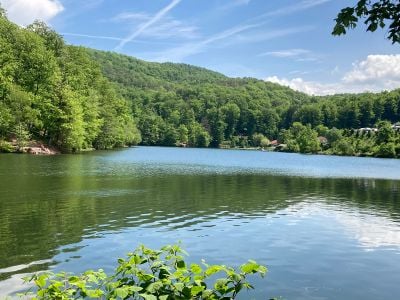
Wiesenbeker Teich is an artificial reservoir near Bad Lauterberg im Harz, impounded by an earth dam. A straight gravel path leads from the foreground toward the dark water, bordered by tall grasses and a wooden bench on one side and a wire fence on the other. Near the centre of the water stand a small gabled building with a dark roof and a taller block-like structure, with forested hills rising behind.
The pond was created in 1715 to supply water to the Aufrichtigkeit copper mine in Lauterberg. As mining needs grew, it later became a key part of the water supply for the Lauterberger Königshütte ironworks.
The Wiesenbeker Teich is part of the Upper Harz Water Management system, a UNESCO World Heritage Site made up of ponds and channels once built for mining. Walking along the shore, visitors can still see the old earthen dam and the channels that once carried water across the hills.
The southern shore has a camping site with leisure facilities and a sandy beach, and the bathing areas are open to visitors who are not staying at the campsite. A small water-ski installation has operated in the middle of the pond since the 2020s, and the DLRG Bad Lauterberg runs a station on the southern shore. The pond lies on a stage of the Harzer Baudensteig trail.
The dam's seal is made of turf sods (Rasensoden), not peat, and they were laid in the middle of the dam rather than on the water-facing slope — the first time this was done in the Harz. The same central placement was used for the Striegel, the outlet control shaft. Every later Upper Harz pond was built this way, known as the Lauterbergische Teichbauweise.
The community of curious travelers
AroundUs brings together thousands of curated places, local tips, and hidden gems, enriched daily by 92,641 contributors worldwide.