St. Emmeram, church building in Bavaria, Germany
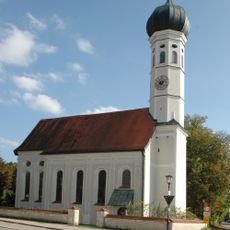
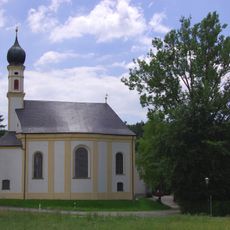
St. Emmeram is a single-nave Baroque church in Kleinhelfendorf, built from 1649/50 by Munich court architect Constantin Pader on the site of a 12th-century tuff Romanesque predecessor. The choir and nave are covered by barrel vaults with lunettes resting on flat pilasters with Corinthian capitals, and the walls and ceilings are covered in stucco framing with fruit baskets, garlands and angel heads.
According to legend, Saint Emmeram was tortured and killed in Kleinhelfendorf in 652 on his way to Rome. A baptismal church was consecrated in the 8th century, and the immediate predecessor was built in the 12th century from tuff blocks, of which parts of the nave, tower base and a round-arch frieze survive. In 1466 a Gothic choir replaced the Romanesque apse, the nave was extended west and a five-sided porch added. The tower octagon with onion dome followed in 1631, the nave was rebuilt from 1649/50, and the church was consecrated in 1680.
The church is named after Saint Emmeram, a martyr whose legend connects him to this place. Visitors can see how the veneration of this saint shaped the decoration and purpose of the building, with sculptures and artworks throughout that show his importance to the community.
St. Emmeram stands in Kleinhelfendorf, a parish village in the municipality of Aying southeast of Munich. The interior is lit by two rows of windows: tall round-topped openings between the wall pilasters and round oculi above the moulded cornice. The lower of the two west galleries carries nine painted panels of the Emmeram legend; the organ sits on the upper gallery.
In the tower octagon hangs a four-voice bronze peal whose strike tones run des1, es1, ges1 and b1. The 1631 tower octagon was topped with an onion dome and decorated with stone balls set into the masonry.
The community of curious travelers
AroundUs brings together thousands of curated places, local tips, and hidden gems, enriched daily by 93,505 contributors worldwide.