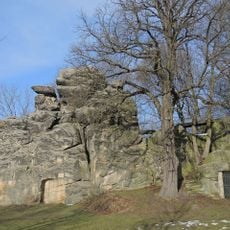
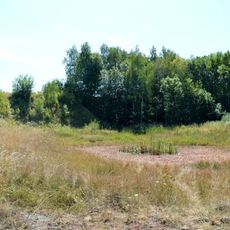
Langenberg limestone quarry, Limestone quarry in Bad Harzburg, Germany
Langenberg is a limestone quarry between Harlingerode and Göttingerode, districts of Bad Harzburg, and Oker, a district of Goslar. It exposes an overturned Upper Jurassic sequence about 200 metres thick, dipping roughly 70 degrees south, from the Lower Coral Oolite to the Upper Süntel Formation. The rock consists of oolite, clay and marlstone, limestone and dolomitic limestone.
Industrial limestone extraction began in 1871 when entrepreneur Adolph Willikens established the operation to produce lime and fertilizers. The products were transported via rail networks to surrounding areas.
The site served as a crucial research location for paleontologists studying Late Jurassic life in northern Europe. These discoveries helped scientists understand what creatures lived here millions of years ago.
The quarry is an active industrial site of Rohstoffbetriebe Oker GmbH & Co., which still produces building materials and agricultural lime here as Kalkwerk Oker; there is no public access. The pit lies between Harlingerode and Göttingerode, a few kilometres north of the Harz northern edge fault. Fossil finds such as the 1999 Europasaurus material went to the Landesmuseum Hannover, so look there for the specimens.
The first Europasaurus bones were found in February 1999 by private collector Holger Lüdtke, not by a museum team. A later survey of about 40 tonnes of limestone by the Dinosaur Park Münchehagen and the University of Hanover confirmed further finds in the Upper Jurassic beds.
The community of curious travelers
AroundUs brings together thousands of curated places, local tips, and hidden gems, enriched daily by 94,652 contributors worldwide.