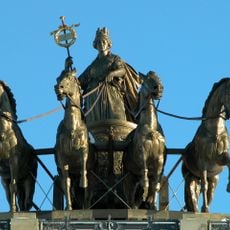
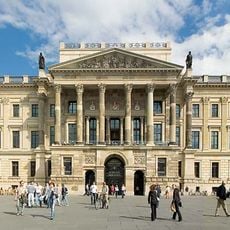
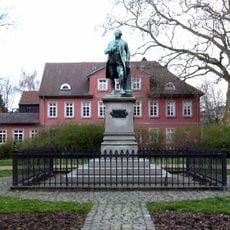
Obelisk, War memorial and historic site at Löwenwall, Brunswick, Germany.
The Obelisk on Löwenwall is a 22-metre cast-iron monument, not granite, designed by Peter Joseph Krahe and cast in 1823 at the Fürstliche Braunschweigische Hüttenwerke in Zorge. Its shaft consists of four bolted plates 12.8 metres long and 25 millimetres thick, set on a stepped inscription base with gilded neoclassical ornaments. Four cast-iron lions modelled by Johann Gottfried Schadow lie at the corners of the three-tiered stone terrace.
The monument was constructed after designs by Peter Joseph Krahe and dedicated in 1823 as a tribute to military sacrifice. Its creation occurred during a period when Germany was reshaping its commemorative traditions.
The monument was funded and initiated by influential citizens of Brunswick, not by the ducal court; Ulrich Knufinke calls it an early case of the people erecting a memorial to their dead rulers. Its inscriptions and the terms "Vaterland" and "Deutschland" were meant to encourage patriotism. A fifth lion, said to be a spare figure for the obelisk, stands on the Löwenbrunnen fountain.
The obelisk stands in a public park and is freely accessible during daylight hours via several walking paths. Bus stops are located nearby, and there is enough space to view the memorial from all sides.
The memorial displays neoclassical design language from the early 19th century, documenting an important period in German commemorative practice. Such monuments became widespread during this era, shaping the appearance of many German cities.
The community of curious travelers
AroundUs brings together thousands of curated places, local tips, and hidden gems, enriched daily by 92,789 contributors worldwide.