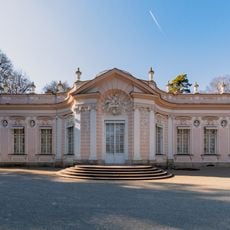
Badenburg, Summer house in Nymphenburg, Munich, Germany
The Badenburg is a bathhouse pavilion on the southern shore of the Badenburger See in the Nymphenburg Palace park, in Munich's Neuhausen-Nymphenburg district. It stands in the southern, landscape-style section of the park, which Friedrich Ludwig Sckell redesigned from 1804 onward; the lake also holds the Apollo temple. The park around it covers 180 hectares within the historic garden wall.
The Badenburg was built from 1716 to 1721 by Joseph Effner for Elector Max Emanuel, as one of the four park palaces of the Nymphenburg grounds. It served as a bathing and pleasure house on the southern Badenburger See, where the court staged water festivities. Its heated pool and tiled bath rooms made it a model of early eighteenth-century bathing culture.
The building remains a place of leisure where visitors experience spaces once used by nobility for relaxation and social gatherings. The arrangement of rooms and their furnishings reveal how bathing and recreation were central to the lifestyle of the upper classes.
The Badenburg stands on the south side of the Badenburger See in the southern, landscape-style half of the park, reached from the palace along the Mittelkanal. The park is enclosed by its historic garden wall, with the Grünes Brunnhaus pumping water for the palace fountain nearby. Allow time to walk between the park buildings, which lie well apart.
The Badenburg's bath was fed by the same Würm water that fills the park canals, and the building stands on the southern Badenburger See beside the Apollotempel. Its heated pool made it a working bathing house, not a decorative pavilion, and the lake it faces was dug as part of the canal system that still supplies the palace fountains.
The community of curious travelers
AroundUs brings together thousands of curated places, local tips, and hidden gems, enriched daily by 92,887 contributors worldwide.