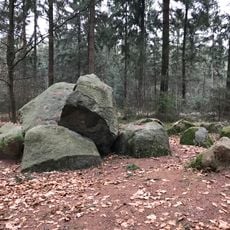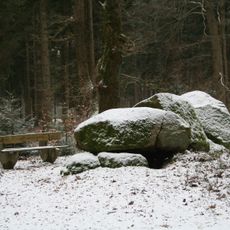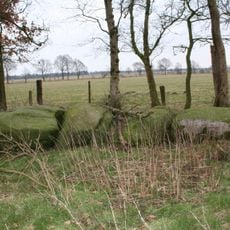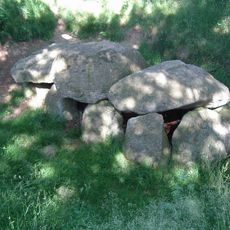
Großsteingrab im Ahlen-Falkenberger Moor, Neolithic burial site in Wanna, Germany
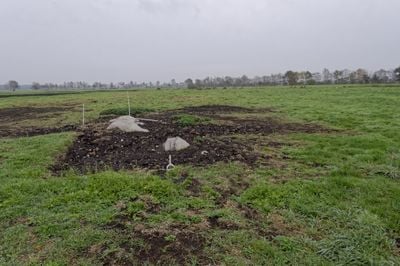
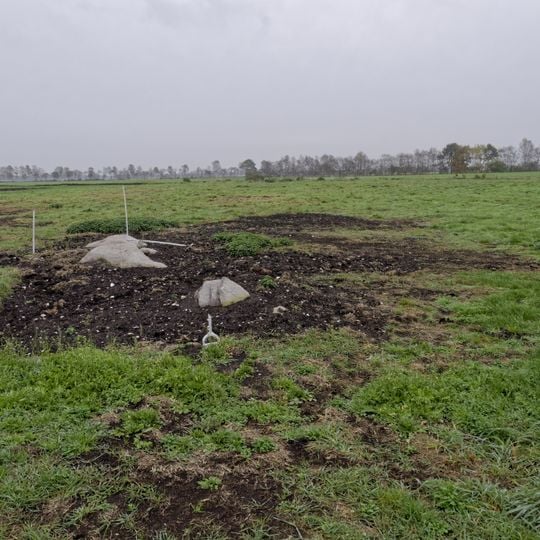
Großsteingrab im Ahlen-Falkenberger Moor is a stone burial chamber with five capstones situated within the wetland landscape of the region. The site lies near the northern shore of Lake Dahlem and is today accessible through interpretation facilities at the location.
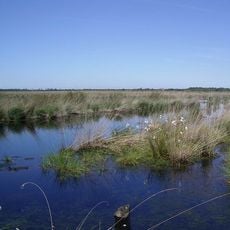
Built around 3200 BCE by the Funnel Beaker culture, the tomb was gradually overgrown by a raised bog that preserved it; the peat cover was complete by about 800 BCE, in the Iron Age. Drainage for peat cutting from the early 20th century and later moor cultivation dried and shrank the bog, so the large capstones emerged from the moor from about the 1930s. In summer 2019 the Lower Saxony Institute for Historical Coastal Research excavated the two visible capstones and the stone packing around them.
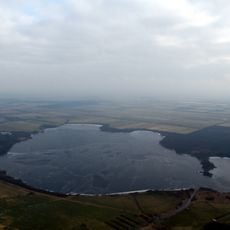
The name Ahlen-Falkenberger Moor refers to the bog that swallowed the tomb; the site lies by the northern shore of the Dahlem Lake, on the edge of a geest hill. About 450 metres west stands a second megalithic tomb, Sprockhoff No. 643. Nearby prehistoric sites, including the Westerwanna megaliths and the Flögeln settlement area, are linked by the Flögeln Prehistory Path.
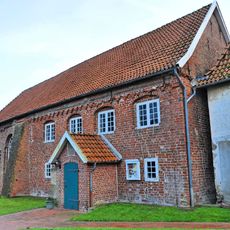
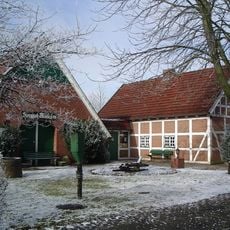
The site is reachable on foot or by bicycle from Wanna, with the Moor Information Center serving as the starting point for a visit. A second megalithic structure lies within accessible distance and can be visited as part of a loop walk.
The tomb's capstones only reappeared around the 1930s, after drainage for peat cutting and later moor cultivation dried and shrank the bog. A 2019 excavation by the Lower Saxony Institute for Historical Coastal Research found two pottery sherds and three amber beads, plus a stone packing around the capstones.
The community of curious travelers
AroundUs brings together thousands of curated places, local tips, and hidden gems, enriched daily by 92,738 contributors worldwide.