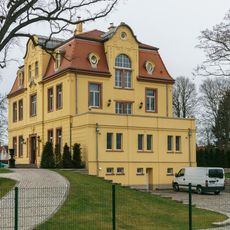
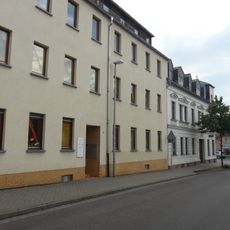
Haus Rabe, Single-family residential house in Zwenkau, Germany.
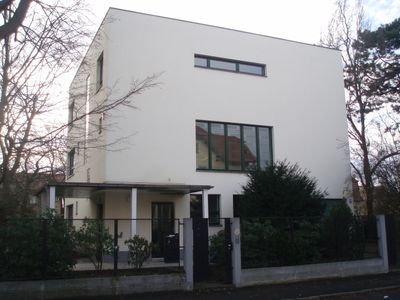
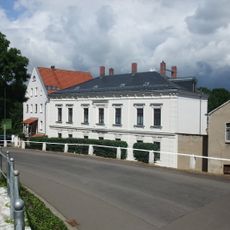
Haus Rabe is a three-story residential building with modernist architecture in Zwenkau. Large window rows, a central hall, and a winter garden connected to the living area characterize the structure.
Erich Rabe, a physician, and his wife Erna commissioned the house in the late 1920s; Erna's acquaintance with the architect's wife led to Adolf Rading's appointment. The design was rejected by approval authorities as too "undeutsch", and permission came partly because trees were to screen the street facade. Construction ran from 1929 to 1931. Erna Rabe, who was Jewish, was deported to Theresienstadt on 13 February 1945 and returned to Zwenkau after the war.
The interior reveals modernist design principles through metal sculptures, geometric forms, and deliberate color choices that shape the spaces. These artistic elements reflect the design ambitions that guided the home's creation.
The ground floor was originally arranged as a medical practice with a separate entrance, while the upper floors contained family quarters and private living spaces. This practical layout allowed professional and private life to be spatially separated.
The living hall is dominated by a four-part metal composition by Oskar Schlemmer, preserved in its original state: the figure Homo (figure T), a relief figure, an axis cross and a head in profile. Schlemmer had designed the Homo figure at the Bauhaus in Weimar in 1920; the five-metre profile head was formed from a band of copper sheet. A tube-lamp construction lights it.
The community of curious travelers
AroundUs brings together thousands of curated places, local tips, and hidden gems, enriched daily by 93,076 contributors worldwide.