Johanneskirche, Lutheran church in Weimar, Germany
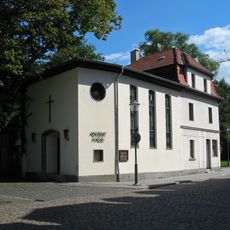
The Johanneskirche is a rectangular, towerless hall church built from 1938 to 1941 to a design by the Weimar architect Hans Vogel. From outside it is barely recognisable as a church; its only exterior ornament is the entrance portal with six reliefs by sculptor Rudolf Weber, carved in foam limestone from Gutendorf. Inside, a glass wall installed in 1953 separates the gallery from the nave, forming a heated winter church.
The church was built between 1938 and 1941 under architect Hans Vogel's direction and received its current name in 1947. This renaming marked a fresh start for the building after the Second World War.
The name changed from Herzog-Bernhard-Kirche to Johanneskirche in 1947, referring to John the Baptist. The parish uses the building mainly for children's, youth and family church events, and a Capoeira group rehearses there. The stage-like chancel is panelled in dark wood.
Visitors should note that prior arrangements may be needed for viewing, as the church primarily serves its congregation. The building is accessible and easily reached by public transport in the city center.
The six reliefs around the entrance portal were carved by sculptor Rudolf Weber of Oberweimar from Gutendorf foam limestone. One panel shows a fallen soldier with another standing over him, and another an SA man with a sidearm on his belt, imagery matching the National Socialist cult of the dead. The church appears in the ZDF documentary series Böse Bauten.
The community of curious travelers
AroundUs brings together thousands of curated places, local tips, and hidden gems, enriched daily by 92,985 contributors worldwide.