Düker, Inverted siphon in Augsburg, Germany
The Düker is an inverted siphon system in Augsburg where two streams cross underground. The structure uses pressurized pipes that channel water downward and through the intersection point in a closed system.
The Galgenablass is more than 500 years old: the Grenzgraben, which marked the border between the Free Imperial City of Augsburg and the Electorate of Bavaria until 1806, has crossed the Siebenbrunner Bach here since about 1500, originally in a wooden bridge. A sluice gate hung from a gallows-like timber frame, which gave the crossing its name. In 1870 the Siebenbrunner Bach was deepened to increase the output of the nearby mechanical weaving mill.
The name Galgenablass comes from a sluice gate whose sliding panel hung from a gallows-like timber frame, a structure of post and cantilever beam; it has nothing to do with an execution site. The crossing long separated utility water from drinking water, and the Grenzgraben marked the border between the Free Imperial City of Augsburg and the Electorate of Bavaria until 1806.
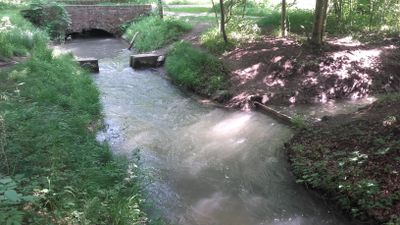
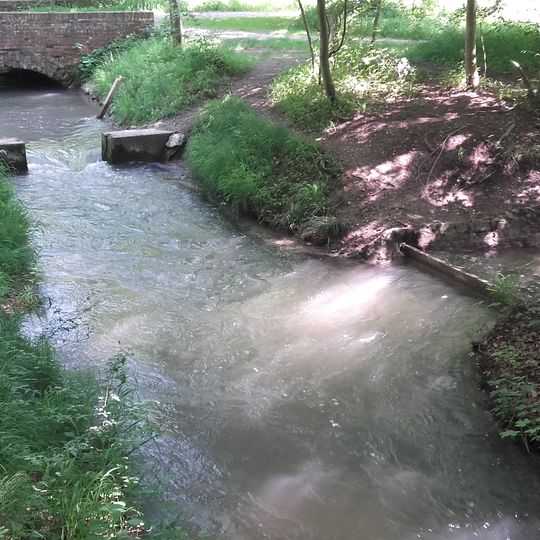
The Galgenablass lies in the Siebentischwald near Siebenbrunner Strasse, about halfway between Siebenbrunn and the Hochablass. It cannot be reached directly by public transport or car; visitors come on foot or by bicycle. The visible parts are two low grey concrete blocks at the water's surface, one upstream on the left bank and one downstream slightly to its right.
The name comes from the crane-like timber frame that once held a sluice gate here until the 19th century; builders call a support with a cantilever a "Galgen". It has nothing to do with a gallows or execution site. The crossing itself is over 500 years old.
The community of curious travelers
AroundUs brings together thousands of curated places, local tips, and hidden gems, enriched daily by 94,447 contributors worldwide.