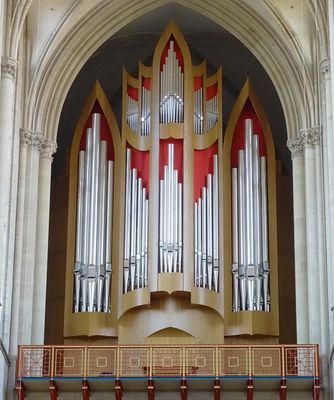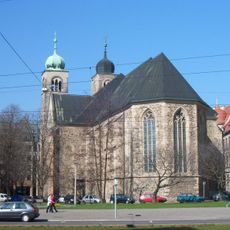
Pipe organs of Magdeburg Cathedral, Pipe organ in Magdeburg Cathedral, Magdeburg, Germany
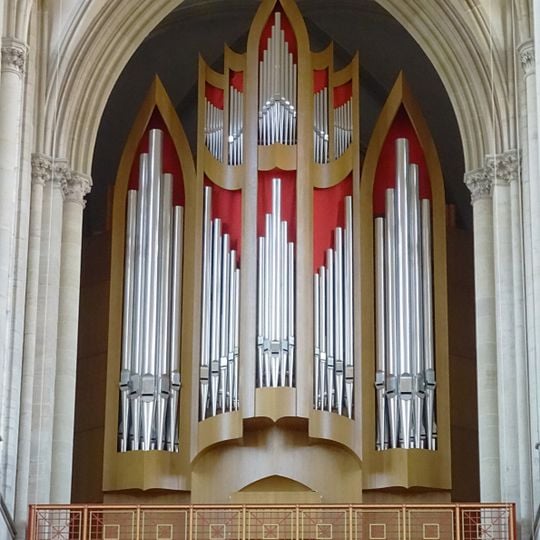
The pipe organs of Magdeburg Cathedral comprise four instruments, with the main organ consisting of multiple sections such as the Solowerk and Cis-Seite-Pedal divisions. These organs are positioned throughout the cathedral's interior so their sound fills the large space.
An organist at the Ottonian predecessor cathedral is documented in 1179; that building burned in 1207. By 1377, when Emperor Charles IV visited, clergy sang the Te Deum "with the organs", implying two instruments. Heinrich Compenius the Younger built a new organ in 1604–1605 with 42 sounding stops; its gilded facade included a mechanical rooster that crowed and flapped its wings.
The organs are central to the liturgical life of the cathedral and shape the spiritual experience of visitors during masses and concerts. They are part of the church music tradition that is regularly heard when organists fill the church with their sound.
The best opportunities to hear the organs are during regular services, when the instruments sound in their original context. Visitors should check ahead to find when masses are held to ensure an organist will be present.
The 1604–1605 Compenius organ had a gilded rooster on the highest point of its facade; an oboe register imitated its crowing and it could flap its wings. Probably meant as a symbol of Peter's denial, it became a figure of entertainment for churchgoers. The facade was stored in the tower in 1830.
The community of curious travelers
AroundUs brings together thousands of curated places, local tips, and hidden gems, enriched daily by 92,732 contributors worldwide.