Krefeld Stadtgarten, Public garden in central Krefeld, Germany
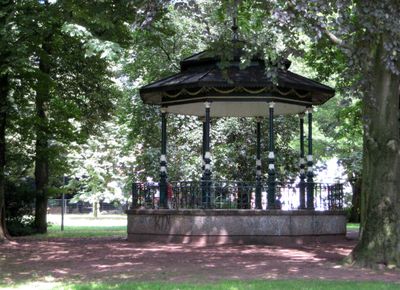
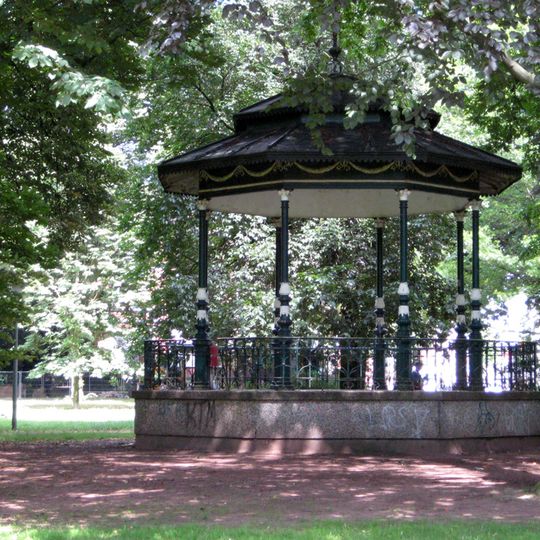
Krefeld Stadtgarten is a public green space covering 4.4 hectares between Nordwall and St. Anton Street, featuring mature tree-lined paths, a music pavilion, and multiple fountains throughout the grounds. The southern section is organized with a star-shaped path network, while the northern area has a simpler layout, with a circular route connecting the two sections.
The site began as a cemetery in 1814 but was converted into a public park in 1879 when burials ended due to the city's expansion into residential areas. This change allowed a central location once reserved for the dead to serve the living community instead.
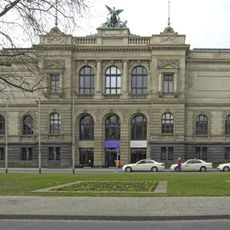
Gravestones of Krefeld merchant families such as Heilmann, Schumacher and Heydweiller still stand among the lawns and paths, and the park is named simply for its function as the city garden, not after a family. A ceramic bust of the conductor and composer Carl Wilhelm, who led the Krefeld Liedertafel choir from 1841 to 1864, stands in the grounds; the 1877 bronze original is kept in the Kaiser-Wilhelm-Museum.
The park lies between Nordwall and St.-Anton-Straße, with entrances on both sides; the 2015 renewal created new entrance areas and strengthened the historic main axes. The paths are level and suited to walking, and the grounds around the music pavilion and fountain were revived as open squares. The southern side holds a children's playground.
Several original gravestones remain integrated into the park's design, serving as quiet reminders of its cemetery past. One notable stone belongs to a family who later established a large forest in the surrounding region.
The community of curious travelers
AroundUs brings together thousands of curated places, local tips, and hidden gems, enriched daily by 92,864 contributors worldwide.