Galerie an der Ruhr, Art museum in Mülheim an der Ruhr, Germany
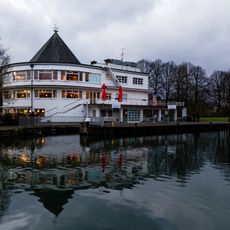
Galerie an der Ruhr is an art museum in a Gründerzeit villa at Ruhrstraße 3, featuring several exhibition levels with varying ceiling heights. The building combines classical architecture with modern display spaces for contemporary artworks.
Villa Artis was built around 1820 and used as a counting house with a colonial goods warehouse by Johann Wilhelm Meininghaus and his wife Henriette Troost, who exchanged the property with Ludwig Lindgens in 1856. Wilhelm Schmitz-Scholl bought it for 5,000 talers; after his family moved out, builder Ernst Niebel remodelled it for industrialist Carl Nedelmann, matching the stucco to Nedelmann's villa. The Gesellschaft für Stromwirtschaft used it from 1955 to 2012, and since 2012 it has housed the RUHR GALLERY.
Since 2012 local art associations have used the villa as an art museum, the "RUHR GALLERY" and a studio house. The building is named Villa Schmitz-Scholl after the family of Wilhelm Schmitz-Scholl (1831–1887) and Luise Scholl (1834–1888), founders of the Tengelmann group. The gallery name refers to the Ruhr, on whose bank the Ruhranlage park borders the grounds.
The spaces are distributed across several levels, so visitors should be prepared to use stairs or the available elevators. Public transportation stops nearby, making arrival straightforward.
The entrance portal at Ruhrstraße 3 is compared by Roland Günter to the portal of the Whitechapel Art Gallery in London. On the main façade, the gable shows basilisks, snakes and insects; at the rear facing the Ruhr an oriel with an onion dome was added.
The community of curious travelers
AroundUs brings together thousands of curated places, local tips, and hidden gems, enriched daily by 94,391 contributors worldwide.