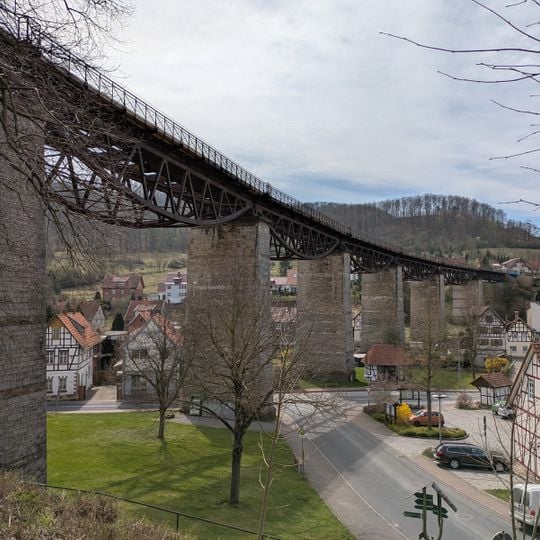
Lengenfelder Viadukt, Railway viaduct in Südeichsfeld, Germany.
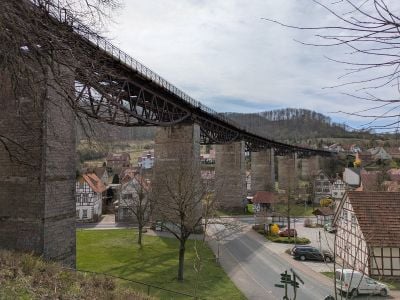
Lengenfelder Viadukt is a 244.10-metre railway viaduct on the former Leinefelde–Treysa line of the Berlin–Metz Kanonenbahn, crossing the Frieda valley and the village of Lengenfeld unterm Stein. Seven piers of regional Muschelkalk limestone carry six fish-belly girders of 33.30 metres and two box girders of 17 metres, forming eight openings; the deck lies in a 400-metre curve with a 1:110 gradient.
The viaduct was built between 1877 and 1879 and opened in 1880 as part of the Berlin to Metz railway line. It enabled the railway to cross the Frieda Valley and became an important link in regional transportation networks.
Since 15 May 2006 the Eichsfeld Cannon Railway Association has run a draisine line over the viaduct, and between 2006 and 2012 it carried 170,000 guests. The bridge is a protected technical monument and serves as the landmark of Lengenfeld unterm Stein.
The viaduct is accessible today via the draisine rail track operated by the Eichsfeld Railway Association, where visitors can explore the structure using pedal-powered rail vehicles. Access is seasonal and offers an immediate experience of the viaduct from a rail perspective.
The viaduct was never comprehensively renovated, unlike other bridges on the line. By the early 1940s, damage and structural flaws in the superstructure forced a speed limit of 10 km/h. From 1945 to 1965, a bridge watch of the Deutsche Reichsbahn was stationed here, walking the structure several times daily to check for damage.
The community of curious travelers
AroundUs brings together thousands of curated places, local tips, and hidden gems, enriched daily by 93,296 contributors worldwide.