Torhaus an der Erfurter Straße, Neoclassical gatehouse near central Weimar, Germany
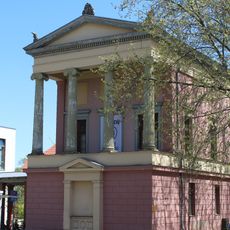
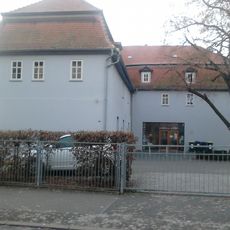
The Torhaus an der Erfurter Straße is a single-storey neoclassical building with a central gable, two unfluted Roman-Doric columns in front of the entrance niche, and a hipped roof. Its front is a classical dummy facade: above the semicircular upper window sit a Corinthian helmet and sword, below them the grand-ducal and Weimar city coats of arms, and above the columns a metope-triglyph frieze. It stands between Erfurter Straße and Hoffmann-von-Fallersleben-Straße.
Between 1822 and 1824, architect Clemens Wenzeslaus Coudray designed this building as a toll collection point connecting the outer and inner Erfurt gates. From 1887, it served additional public functions, evolving with changing urban needs over the following decades.
Above the round upper window, the facade carries a Corinthian helmet and a sword in stucco; below them sit the grand-ducal coat of arms and Weimar's city arms. The columns and architrave are topped by a Doric metope-and-triglyph frieze. The front is a classical blind facade, so the ornament announces the building's role as a toll gate on the Erfurt road.
The building underwent restoration by private investors in 2009 and gained protected status as a result. It is easy to reach, located right next to the central bus station turning loop and easily accessible by public transport.
From 1887 onward, it served as a railway station reception building at the Erfurt Gate before later becoming a police station and travel agency. This varied functional history shows how the structure adapted to the changing needs of the city over time.
The community of curious travelers
AroundUs brings together thousands of curated places, local tips, and hidden gems, enriched daily by 94,430 contributors worldwide.