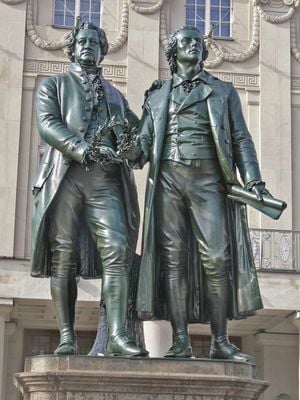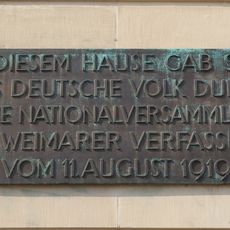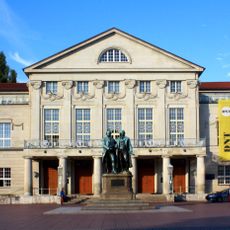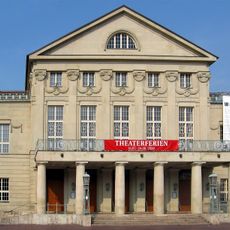
Goethe–Schiller Monument, Bronze statue and memorial near Theater Square, Weimar, Germany.
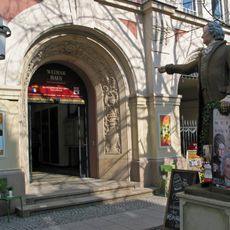
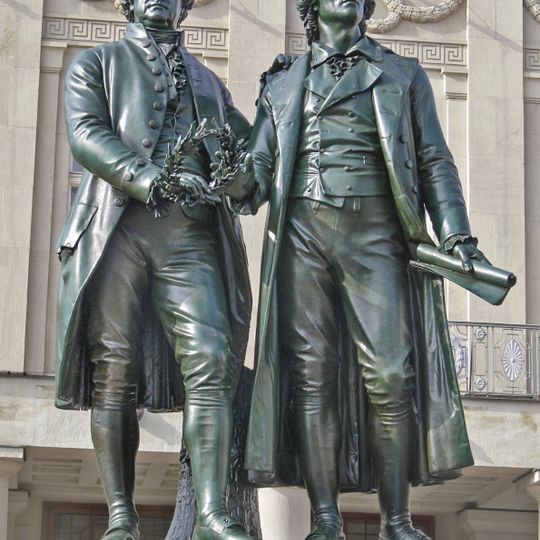
The Goethe–Schiller Monument is a bronze double statue of Johann Wolfgang von Goethe and Friedrich von Schiller, standing side by side on Theaterplatz in front of the German National Theater. Goethe, on the left, rests his left hand on Schiller's shoulder and holds a laurel wreath in his right; Schiller holds a rolled document. Both figures are the same height, though Schiller was taller in life.
Grand Duke Carl Alexander of Saxe-Weimar-Eisenach commissioned the monument, and Dresden sculptor Ernst Rietschel designed it; Christian Daniel Rauch had declined the commission because he refused to depict the poets in contemporary dress. Ferdinand von Miller cast the bronze in Munich in 1857 from melted Ottoman cannon barrels taken at the Battle of Navarino. It was unveiled on 4 September 1857, the centenary of Grand Duke Karl August's birth, and Franz Liszt's Faust Symphony premiered in Weimar the next day.
The monument honors the literary partnership between Goethe and Schiller, who worked together during their time in Weimar. The two figures stand side by side, symbolizing the close artistic bond that shaped this era.
The monument stands on Theaterplatz in front of the German National Theater, on the square that Goethe directed from 1791 to 1815. The bronze figures are mounted on a polished Baden granite pedestal, so the inscription on its front is at eye level. The square is open and level, and the monument can be walked around to see the sculptor's signature on the back of the oak stump.
Although the two writers were different heights in real life, the sculpture depicts them at precisely equal stature. This was an intentional artistic choice to express their equal importance in literary history.
The community of curious travelers
AroundUs brings together thousands of curated places, local tips, and hidden gems, enriched daily by 93,531 contributors worldwide.