Mount Ida, Mountain summit in Mylopotamos Municipality, Rethymno, Greece
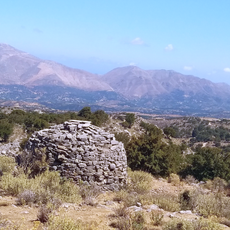
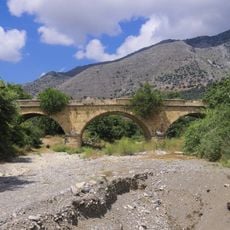
Mount Ida, also called Psiloritis, is a mountain massif in central Crete whose highest summit, Timios Stavros, rises to 2,456 metres. Snow lies in patches on dark rock along the upper ridge, which continues east to Mount Agathias and west to Mount Stolistra. Below the snowline, slopes descend to forested hills and the plain with fields and scattered buildings at its foot.
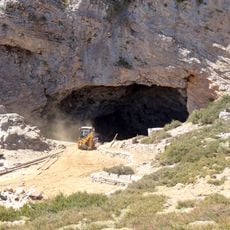
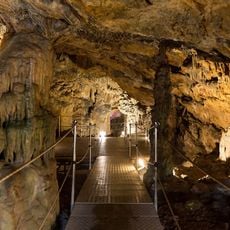
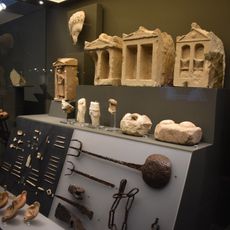
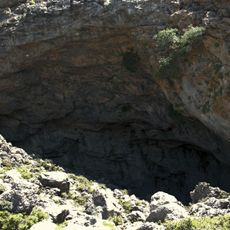
The mountain was revered in ancient Greek mythology and culture, particularly because of a cave believed to be Zeus's birthplace. Its significance traces back to Minoan civilizations, whose pottery and artifacts have been discovered in its caves.
The name Ida appears in Linear A inscriptions on double axes from the Arkalochori cave, read by archaeologist Nikolaos Boufidis as "Ida he mater", the Idaian Mother. The Idaean Cave was venerated by Minoans and later Greeks, who rededicated it to Zeus; votive seals and ivories were found there. Nearby Axos depicted a tripod on its coins, likely marking the cave's oracle.
Visitors should bring plenty of water, food, sturdy footwear, and warm layers since temperatures drop noticeably at higher elevations. The mountain can be climbed throughout the year, but conditions vary significantly depending on the season.
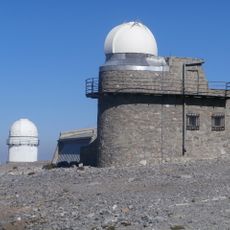
At a secondary peak around 1,750 meters sits the Skinakas Observatory, equipped with two telescopes for astronomical research and observations. This facility makes use of Crete's clear skies for scientific discovery in a setting far removed from light pollution.
The community of curious travelers
AroundUs brings together thousands of curated places, local tips, and hidden gems, enriched daily by 92,853 contributors worldwide.