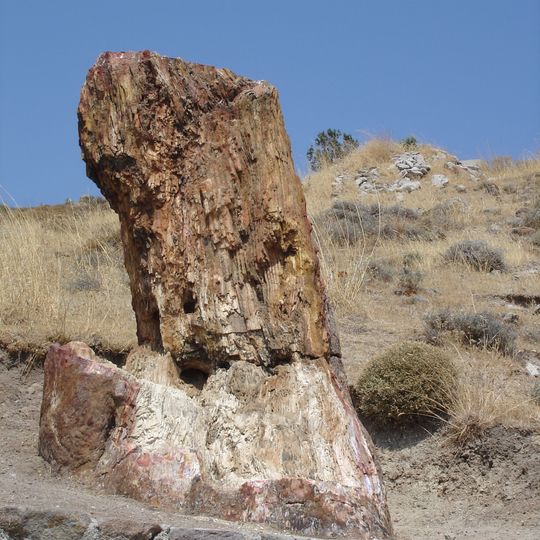
Petrified forest of Lesbos, Petrified forest in Lesbos, Greece
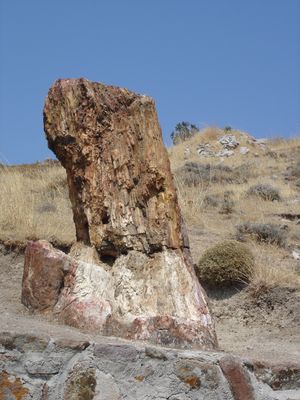
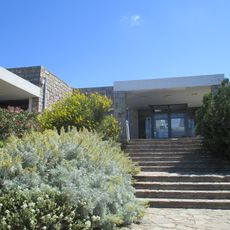
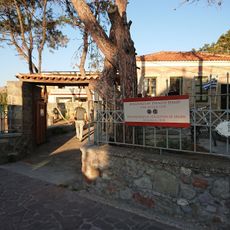
The Petrified Forest of Lesbos covers 150 square kilometres of western Lesbos between Sigri, Eressos and Antissa, where standing and fallen fossilised trunks lie on volcanic slopes. The main park at Bali Alonia, 286 stremmata, has walking paths and a 20-metre lying trunk found near its entrance in 1987. The Natural History Museum in Sigri, founded in 1994, displays fossils from the site.
The Petrified Forest of Lesbos formed between 17 and 20 million years ago, when successive volcanic eruptions covered the vegetation in lava and ash. Silica-rich hydrothermal solutions then soaked the ash and replaced the trees' organic matter with silicon dioxide, preserving annual rings and bark. The Greek state expropriated the Baly Alonia and Hamandroula sites in 1966, and a 1985 presidential decree made the 150,000-stremma area a protected natural monument with five parks.
The Natural History Museum of the Lesvos Petrified Forest, founded in Sigri in 1994, studies and protects the site and has run systematic excavations since 1997. It became a founding member of the European Geoparks Network in 2000 and joined UNESCO's Global Geoparks Network in 2004. The island's first fossil plant study is attributed to Theophrastus of Lesbos in the 4th century BC.
The park areas are accessible during daylight hours, and visiting early in the day helps avoid crowds while providing good light for viewing the formations. Sturdy footwear is recommended since the terrain is uneven with rocky paths throughout.
The forest's largest trunk, found at the Plaka park about 500 metres south of Sigri, measures 3.7 metres across and 14 metres around. It was located by geophysical survey before excavation, and the park opened in July 2005. The trunk is the biggest yet recorded in the forest.
The community of curious travelers
AroundUs brings together thousands of curated places, local tips, and hidden gems, enriched daily by 93,072 contributors worldwide.