Aphrodite of Syracuse, Roman marble statue in Athens, Greece
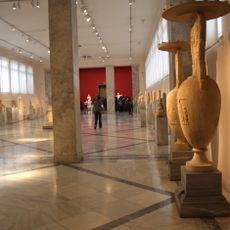
The Aphrodite of Syracuse is a marble statue in the National Archaeological Museum of Athens, standing about 1.80 meters tall and carved from Parian marble. The figure shows the goddess in a standing position with drapery partially covering her body.
The statue was discovered in Baiae, Italy, and later entered European private collections before coming to Athens. Antonio Canova performed restoration work on the piece, reconstructing missing elements such as the head and right arm.
The name "of Syracuse" links it to a Venus Landolina statue in Syracuse, Sicily, found by archaeologist Saverio Landolina in the ruins of a Greek nymphaeum. The Athens figure follows the Venus pudica pose, one hand at the breast and one over the groin, a type derived from Praxiteles' Aphrodite of Cnidus.
The work is on display in the museum under inventory number 3524 and can be viewed during regular opening hours. Visitors should be aware that the head and certain limbs are modern reconstructions.
The figure is a Roman copy of a Greek original and was donated to the museum in 1924 by Michael Embeirikos, who acquired it from Lord Hope's renowned collection. This provenance makes it a valuable record of how ancient artworks circulated between Italy and Greece.
The community of curious travelers
AroundUs brings together thousands of curated places, local tips, and hidden gems, enriched daily by 93,483 contributors worldwide.