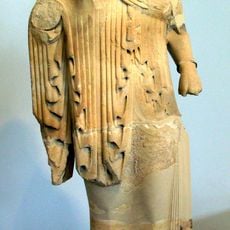
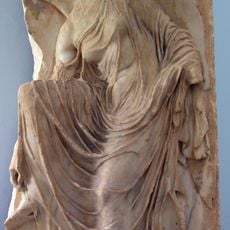
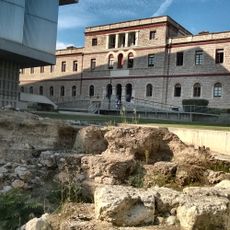
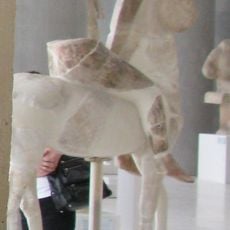
Mourning Athena, Classical marble relief sculpture at Acropolis Museum, Greece
The Mourning Athena is a marble relief, 0.48 m high, carved around 460 BC in Attic workshops in the severe style. Athena wears a Corinthian helmet and a peplos clasped at the shoulders and cinched at the waist; her right hand rests on her hip, her left grasps a spear, her head is bowed, and her left leg crosses over the right. A rectangular object stands at the viewer's right.
The relief was created during the classical period around 460 BCE and was discovered in 1888 during archaeological excavations on the Acropolis. This find is considered an important example of early classical art development in Athens.
The relief's modern name comes from the bowed head, read since its discovery as grief or pensiveness; some scholars instead see an exhausted Athena, others no emotion at all. The rectangular object she faces is variously identified as a grave stele, a race-course marker, or a block that once held a small figure such as the infant Erichthonius.
The work is housed in a climate-controlled exhibition room at the Acropolis Museum, where it is preserved under controlled conditions. Visitors should take time to examine the fine details and surface texture of the marble from different angles.
The spatial arrangement of the figure is unconventional, with the body weight resting on one leg and an ease of posture that feels almost melancholy. This informal stance differs markedly from the typically rigid depictions of deities in the classical period.
The community of curious travelers
AroundUs brings together thousands of curated places, local tips, and hidden gems, enriched daily by 92,837 contributors worldwide.