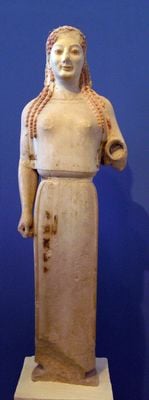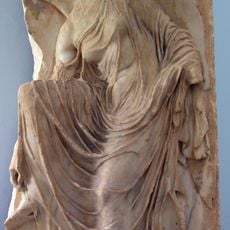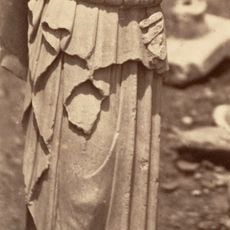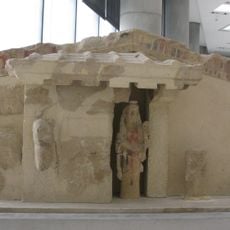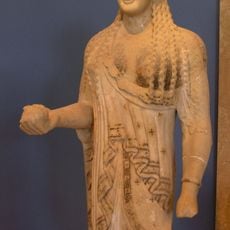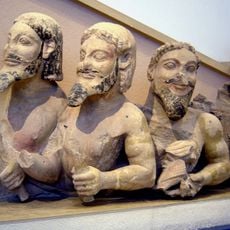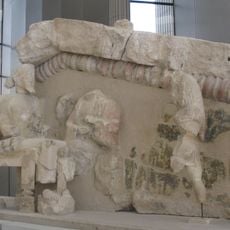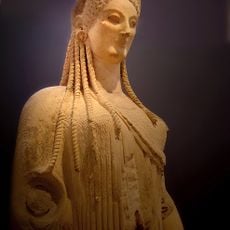
Peplos Kore, Marble statue at Acropolis Museum, Athens, Greece
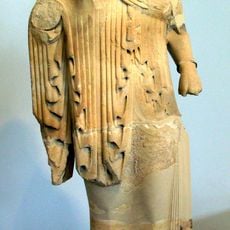
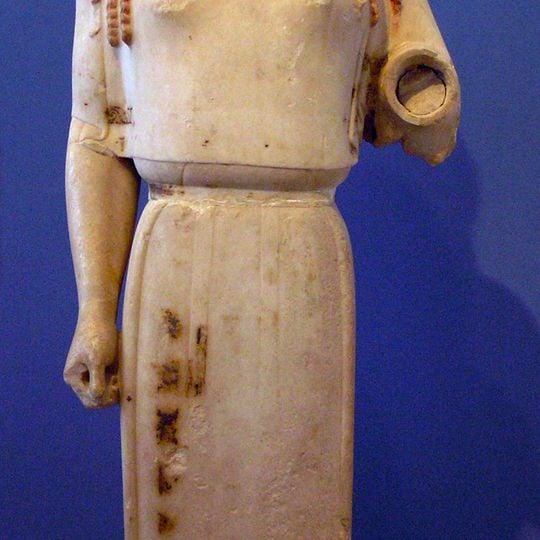
The Peplos Kore is a 118 cm white Parian marble statue of a young woman, carved around 530 BC and found in three pieces in 1886. Her left arm hangs down with the hand curled around a bored hole; the right arm is broken off at the shoulder, leaving a hollow socket. She wears a belted garment with a smooth upper section and a long skirt, and dark brown stains run down the left side of the skirt.
Archaeologists found the figure in 1886 in three sections northwest of the Erechtheion on the Athenian Acropolis and date it to 530 BCE. It probably belonged to the votive offerings that were buried after the Persian destruction in 480 BCE.
The name comes from the peplos, a garment the statue was long thought to wear; scholars now hold that her dress is an Anatolian long robe with a cape, and the Spanish source still calls it a Doric peplos with a chiton. A painted cast made in 1975 in Cambridge, shown beside an unpainted one, illustrates the lost colours.
The statue is displayed in the Acropolis Museum in Athens, where it was moved after being found on the Acropolis in 1886. It is carved in the round but designed to be seen from the front, so the facial details and the archaic smile read best from directly ahead. The left arm was a separate piece of stone and is lost, leaving a hollow socket at the shoulder.
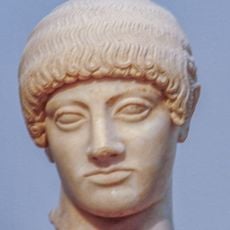
The head shows 35 drill holes that suggest a metal crown or helmet was originally attached. These details indicate the figure may have represented a goddess rather than just a mortal woman.
The community of curious travelers
AroundUs brings together thousands of curated places, local tips, and hidden gems, enriched daily by 92,810 contributors worldwide.