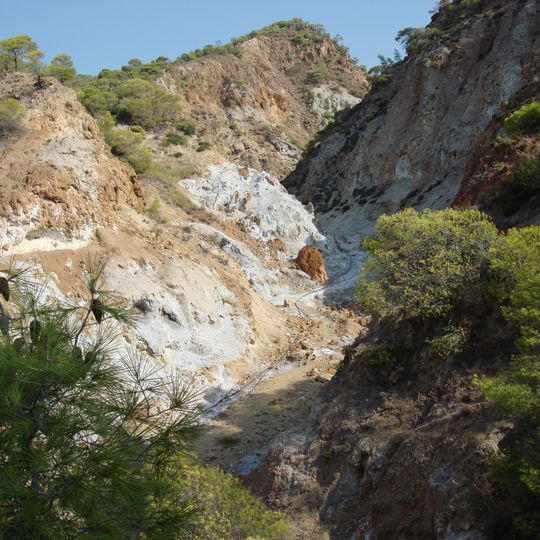
Sousaki volcano, Dormant volcano in Agioi Theodoroi district, Greece
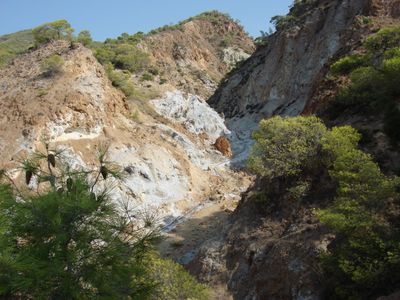
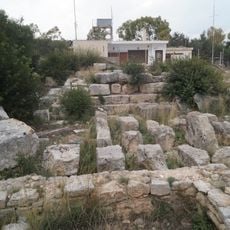
Sousaki volcano is a dormant volcano and solfatara field at the northwest end of the South Aegean Volcanic Arc, in northeastern Corinthia near the Gulf of Megara. It erupted dacite lava, and its geothermal system still releases about one megagram of gas per day at 42 °C, roughly 90% CO2 with under 1% each of CH4 and H2S.
Sousaki was active during the Pliocene and early Quaternary, erupting dacite lava; its last eruption was a lateral one that created new land in the Gulf of Megara. The geothermal system still releases about 1 megagram of gas per day at 42 °C, 90% CO2 with under 1% each of CH4 and H2S. Earthquakes of magnitude 3–4 in 1997 were linked to magma rising in the crust, so future activity is possible.
The settlement of Sousaki, part of the Isthmus municipality of Corinthia, took its name from the volcano around which it grew. It is a coastal village with factories, a campsite and a lighthouse. The last eruption, a side eruption, created new land in the Gulf of Megara, where major port and refinery facilities now stand.
Reaching this site involves walking on unpaved paths through olive groves, so sturdy footwear is necessary and caution is advised due to gas emissions. Check local conditions before visiting, as weather can affect accessibility and comfort at the vents.
The gases emerge at 42 °C and consist of about 90% CO2, with less than 1% each of methane and hydrogen sulfide. The field is a solfatara, a venting area of sulfurous gases, at the northwest end of the South Aegean Volcanic Arc. Earthquakes of magnitude 3–4 in 1997 were linked to magma rising into higher crustal levels, so renewed activity is considered possible.
The community of curious travelers
AroundUs brings together thousands of curated places, local tips, and hidden gems, enriched daily by 92,814 contributors worldwide.