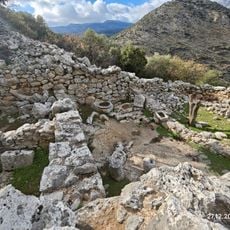
Dreros, Archaeological site near Neapoli, Crete, Greece
Dreros lies on the hill of San Antonio, a southern spur of Mount Kadistos near Neapoli, where two small peaks carry an acropolis each and the Archaic agora sits in the saddle between them. Traces of the city walls survive, and south of the agora are the remains of the Geometric temple of Apollo Delphinios.
Dreros was founded by Dorian settlers in the Geometric period, around the 9th–8th centuries BCE, on a hill already used by a Subminoan community whose necropolis lay on the north slope. It flourished from the 8th to the 6th century BCE, then became a satellite of Knossos in Hellenistic times. It was important enough to be omitted from the pact thirty Cretan cities signed with Eumenes II of Pergamum in 183 BCE, and it survived into the Byzantine period.
The temple of Apollo Delphinios once held bronze statues depicting Apollo, Artemis, and Leto that visitors can now see in museums. These works show how local artisans expressed religious devotion through their craft.
Dreros lies near Neapoli in the Lasithi regional unit, about 16 km northwest of Agios Nikolaos. The excavated area covers two acropoleis with the Archaic agora in the depression between them, so expect walking on uneven ground with little shade. The Temple of Apollo Delphinios sits south of the agora, on the slope of the hill.
The large communal cistern east of the Temple of Apollo was dug in the late 3rd to early 2nd century BCE, yet the Archaic law inscription found inside it dates to about 650 BCE and may once have hung on the temple walls. Two Eteocretan inscriptions on grey schist blocks, excavated there in 1936, were lost during the wartime occupation of Crete.
The community of curious travelers
AroundUs brings together thousands of curated places, local tips, and hidden gems, enriched daily by 94,094 contributors worldwide.