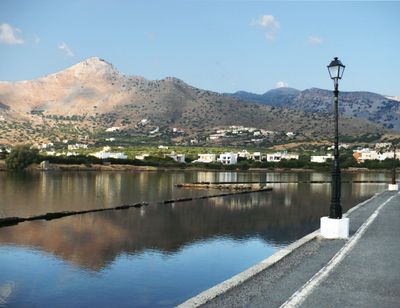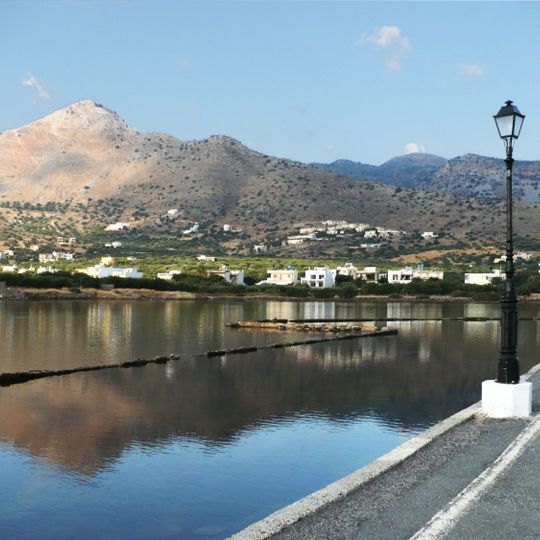
Olous, Archaeological site in Elounda, Greece.
Olous is the sunken ancient city of Elounda, lying in the bay off the isthmus that links the Spinalonga peninsula to the Cretan mainland. Its visible remains are scattered wall bases on the seabed, which swimmers can see below the surface of Elounda Bay.
Olous is known mainly from inscriptions and coins dated between 330 and 280 BC. In 260 BC it became part of Knossos, and in 201 BC it allied with Rhodes before falling under the dominance of Lato; a 134 BC decree names Knossos as arbitrator in disputes between Olous and Lato. In 1960 the Greek historian Anastasios Orlandos excavated a fifth-century AD early Christian basilica, whose mosaic floor names the donors who helped build it.
Olous minted its own coins, most bearing Artemis Britomartis and Zeus with an eagle or dolphin, or an eight-rayed star with the inscription OLOUNTION. A wooden statue of Britomartis in her temple was said to have been carved by Daedalus. The Louvre holds a letter recording the city's agreement with other Cretan cities and the existence of a temple of Asclepius.
Snorkeling in Elounda Bay offers the best views of the submerged remains, as the water is shallow enough to see the structures clearly. Accessibility depends on weather conditions and water levels, so it helps to check local conditions before visiting.
The early Christian basilica on the Spinalonga peninsula dates from the 5th century AD and was excavated in 1960 by the Greek historian Anastasios Orlandos. A mosaic floor in one of its aisles names the donors who paid for the church, and a Doric inscription found there matched a fragment Henri van Effenterre had recorded in the apse in 1937.
The community of curious travelers
AroundUs brings together thousands of curated places, local tips, and hidden gems, enriched daily by 93,083 contributors worldwide.