Kavousi Kastro, Archaeological site from Bronze Age on hilltop near Kavousi, Greece.
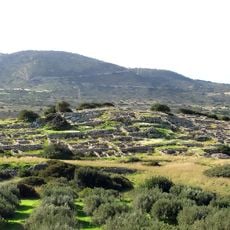
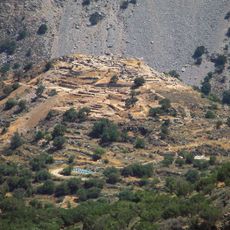
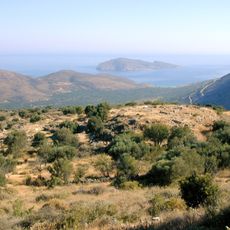
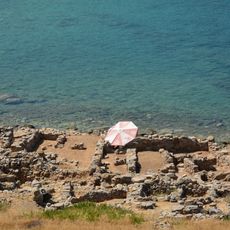
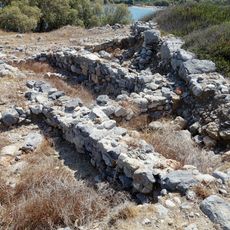
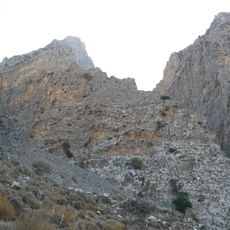
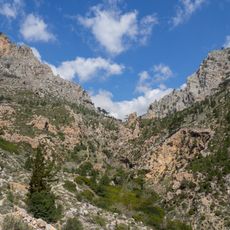
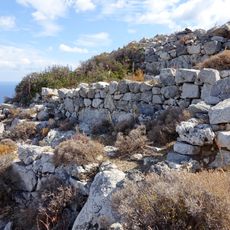
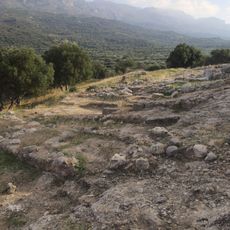
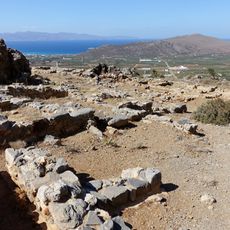
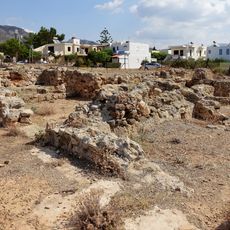
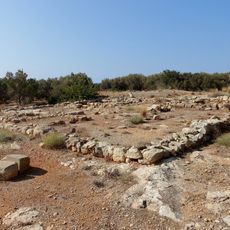
Kavousi Kastro is an archaeological site on a steep hilltop at around 713 meters (2,340 feet) above sea level, with views stretching across the Gulf of Mirabello and the Ierapetra Isthmus. The remains show several house complexes arranged on terraces, revealing how a Bronze Age and Iron Age hilltop settlement was structured.
Kavousi Kastro was founded early in the Late Minoan IIIC period, in the 12th century BCE, and stayed occupied through the Protogeometric, Geometric and Orientalizing periods until it was abandoned in the mid-7th century BCE. Harriet Boyd explored the site briefly in 1900 and found 13 rooms she took for a chieftain's house, now read as separate houses on several terraces. The Kavousi Project cleaned the site in 1982 and excavated it in 1987–1990 and 1992, with conservation from 1993 to 1996.
The way houses sit on terraces up the hillside tells you how people adapted to life after the Minoan collapse, building homes that fit the steep terrain. Their arrangement shows how the community organized itself within the constraints of the landscape.
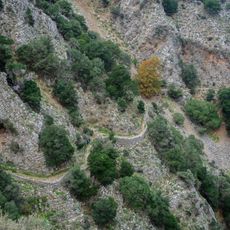
The site is reached on foot from the village of Kavousi via a dirt road and hiking trail, and there is no entrance fee. The climb is steep, so wear sturdy shoes and bring plenty of water, especially if you visit during warm weather.
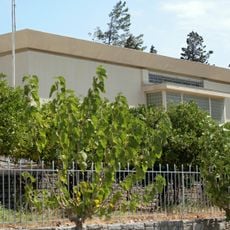
Harriet Boyd, exploring the site in 1900, found 13 rooms and took them for the house of an early chieftain; later work showed they were separate house complexes on several terraces. Excavations by the Kavousi Project followed in 1987–1990 and 1992, with conservation from 1993 to 1996. Finds are now held in the museums of Agios Nikolaos and Ierapetra and at INSTAP-SCEC in Pacheia Ammos.
The community of curious travelers
AroundUs brings together thousands of curated places, local tips, and hidden gems, enriched daily by 93,363 contributors worldwide.