Plaka Bridge, Stone arch bridge in Plaka, Greece
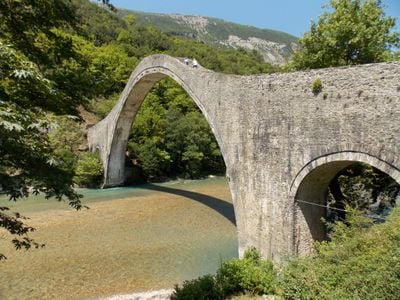
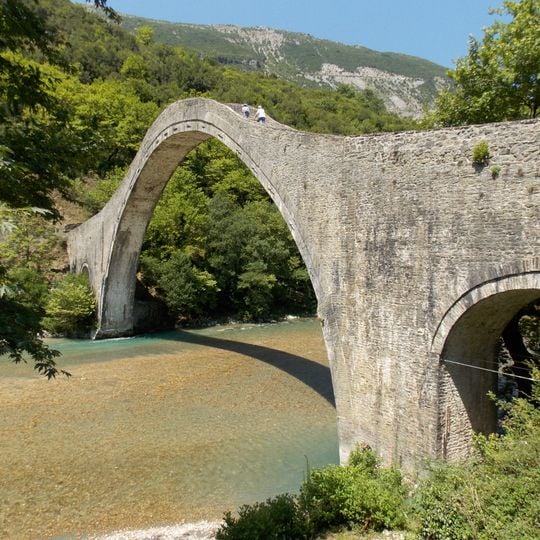
The single-arch structure spans 40 meters across the Arachthos River, rising 21 meters at its apex with a width of 3.2 meters. Massive stone blocks form the characteristic curve that lifts from both riverbanks, connecting the steep gorges of the Tzoumerka mountain range in northwestern Epirus.
Completed in 1866, the crossing marked the frontier between Greece and the Ottoman Empire throughout the 1880s. German forces unsuccessfully attempted to destroy this strategic connection during World War II. Severe flooding in February 2015 completely destroyed the centuries-old structure, prompting a faithful reconstruction that was completed in 2020 using traditional methods and materials.
Local builders developed an unusual method to strengthen the mortar by mixing thousands of eggs with limestone, enhancing the bond between stone blocks. This technique shaped bridge construction across the Epirus region for centuries and was passed down through generations of craftsmen who maintained these vital mountain crossings.
The crossing connects the Tzoumerka mountains with the rest of Epirus and Thessaly, continuing to serve as an important route for surrounding villages. Access is via the road between Plaka and Tzoumerka villages, with parking available near both riverbanks. Visitors can walk along paths on either side to view the structure from multiple angles and explore the nearby gorge.
Following its collapse during flooding in February 2015, specialists began a complete reconstruction using the original design principles. The restoration work received the Europa Nostra Award in 2021 for outstanding achievements in cultural heritage, with the jury particularly praising the authenticity of materials and techniques employed throughout the project.
Location: North Tzoumerka Municipality
Architectural style: Ottoman architecture
Made from material: stone
GPS coordinates: 39.46050,21.02989
Latest update: December 1, 2025 09:56
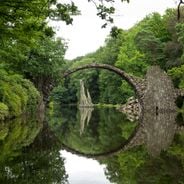
Moon bridges form semicircles that reflect as complete circles in the water. These structures originated in East Asia and combine practical function with deliberate design. The constructions appear in public gardens, botanical spaces and historic landscapes from Japan to California. The collection includes examples from different countries and periods. In Tokyo, the Drum Bridge spans a pond in Golden Gate Park, while the bridge at Kameido Tenjin Shrine forms part of a traditional shrine complex. Dahu Park in Taipei and Rikugien Garden in Tokyo show further variations of this building form. In China, examples range from the Jade Belt Arch in Beijing to multi-arched structures like the Twenty-Four Arch Bridge in Yangzhou. The Anshun Lang Bridge in Chengdu and the Stone Moon Bridge in Suzhou document different regional building styles. The form spread beyond Asia into botanical gardens and park settings worldwide. In the United States, moon bridges appear at Kubota Garden in Seattle, the Huntington Library in San Marino, and as the Humpback Bridge in Virginia. The Japanese garden in Toulouse presents a European example, while Hamilton Gardens in New Zealand holds the southernmost variation. Taiko Bashi in Kanagawa and Sorihashi in Sumiyoshi rank among the most traditional Japanese versions. Each location demonstrates its own interpretation of this architectural form.
Red Church
17.9 km
Vrellis Greek History Museum
17.1 km
Nicopolis Roman Aqueduct
26.2 km
Faneromeni monastery (Leukada)
12 km
Kakarditsa
16.4 km
Theatre of Dodona
22.9 km
Messochora Dam
23.6 km
Dourachani monastery
25.7 km
Papastathis Bridge
17.4 km
Cave Asprochaliko
25.7 km
National Park of Tzoumerka, Peristeri & Arachthos Gorge
10.3 km
1912–1913 War Museum
13.9 km
Kaloutsiani Mosque
26.9 km
Cave Anemotrypa
7.6 km
Protypo Klassiko Lykeio Ioanninon
27 km
Kipina Monastery
14.7 km
Katafydi
10.7 km
Prytaneion (Dodona)
22.8 km
Stadium of Dodona
22.9 km
Bouleuterion in Dodona
22.8 km
Castle at Pente Pigadia
13.1 km
Temple of Herakles (Dodona)
22.8 km
Church of Agia Triada, Pappadates
26.2 km
Khan of Emin Aga
13.9 km
Acropolis of Kastritsa
21.2 km
Church of Ypapanti, Lepiana
7.1 km
Moni Agiou Georgiou, Vourgareli
16.2 km
Monastery of Saint Catherine, Katarraktis
6.9 kmReviews
Visited this place? Tap the stars to rate it and share your experience / photos with the community! Try now! You can cancel it anytime.
Discover hidden gems everywhere you go!
From secret cafés to breathtaking viewpoints, skip the crowded tourist spots and find places that match your style. Our app makes it easy with voice search, smart filtering, route optimization, and insider tips from travelers worldwide. Download now for the complete mobile experience.
A unique approach to discovering new places❞
— Le Figaro
All the places worth exploring❞
— France Info
A tailor-made excursion in just a few clicks❞
— 20 Minutes