Omphalos of Delphi, Ancient marble stele in Delphi, Greece.
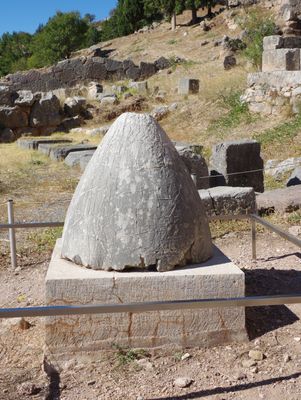
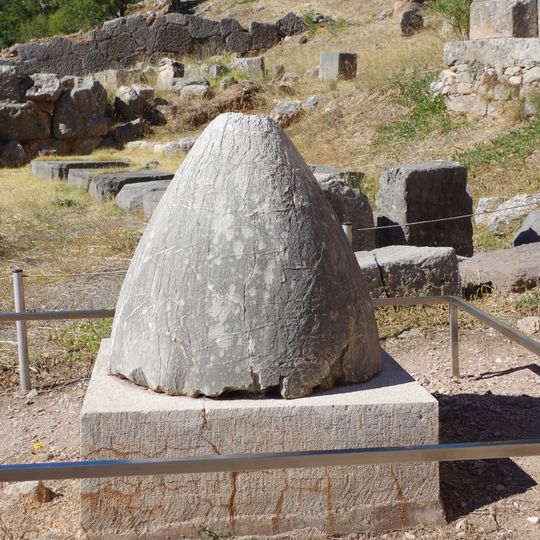
The Omphalos of Delphi is a pale grey marble stone shaped like a beehive, widest near the bottom and tapering to a blunt rounded top, its surface carved with a net of shallow intersecting lines. It rests on a rectangular lighter stone base with red-brown streaks. The original is kept in the Delphi Archaeological Museum, with a simplified copy at the find site.
The omphalos marked the navel of the Earth, where, in the myth told by Hesiod, Zeus set up the stone Rhea had given Kronos to swallow. Pausanias, visiting in the 2nd century AD, described an oval stone kept in the adyton beside the tripod and bay leaves, wrapped in wool with gilded eagles on top. French archaeologists have shown the omphalos was mounted on the bronze tripod held by the three Athenian dancers.
The Greek word omphalos means navel, and the stone marked the navel of the Earth. Pausanias, who visited in the 2nd century AD, records that the stone was wrapped in a woolen mesh with precious stones shaped like a mermaid and two gilded eagles fixed on top. The Pythia sat on a tripod above the omphalos, which sealed a crack from which volcanic gases escaped.
The original stone is housed and can be viewed at the Delphi Archaeological Museum. A simplified replica stands at the excavation site to help visitors visualize where it once stood in the sanctuary.
Pausanias, writing in the 2nd century AD, records that the stone was wrapped in a woolen mesh and kept in the adyton beside the tripod and the bay leaves. Within the wool he saw precious stones shaped like a mermaid, with two gilded eagles fixed on top.
The community of curious travelers
AroundUs brings together thousands of curated places, local tips, and hidden gems, enriched daily by 92,812 contributors worldwide.