Bay of Navarino, Natural cove in Messenia, Greece
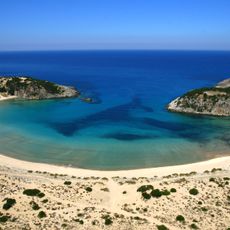
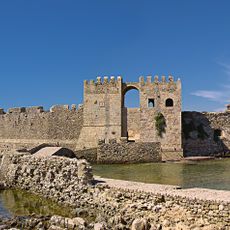
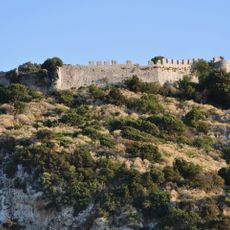
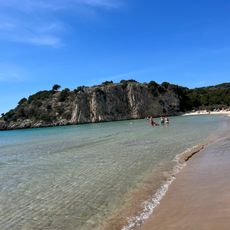
The Bay of Navarino is a small, deep inlet of the Ionian Sea in Messenia, on the southwestern coast of the Peloponnese, almost fully cut off from open water by land. The island of Sfaktiria closes it to the west as a vast breakwater, leaving the narrow Sikia channel to the north and a wider passage to the south. Pylos lies on its southern shore, and the New Navarino fortress (Neokastron) stands at the southern entrance, the Old Navarino fortress (Palaeokastron) at the northern one.
On 20 October 1827, a combined British, French and Russian squadron defeated the Ottoman-Egyptian fleet of Ibrahim Pasha in the bay during the Greek Revolution. The battle secured Greek independence from the Ottoman Empire. Mass graves remain: Russians on Sfaktiria, British on Chelonisi and French on Pylos islet.
The name Navarino may derive, by one account, from Avars who settled in the area. The bay's name is also tied to ancient Pylos, the seat of the mythical king Nestor, described by Homer in the Odyssey; the modern town of Pylos, founded in 1828, took its name from that older site north near Chora.
The cove is accessible through two channels: a broad southern entrance and the northern Sikias passage, both offering protection from Mediterranean winds. Visitors should be aware of varying water conditions and local currents.
Sfaktiria, the island shielding the bay, was the site of a battle in 425 BC during the Peloponnesian War. Today it holds a mass grave of Russian sailors killed in the 1827 naval battle, one of three memorial burial sites on the bay's shores.
The community of curious travelers
AroundUs brings together thousands of curated places, local tips, and hidden gems, enriched daily by 92,825 contributors worldwide.