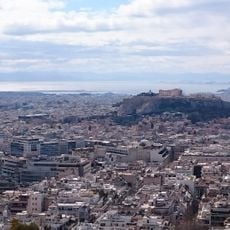
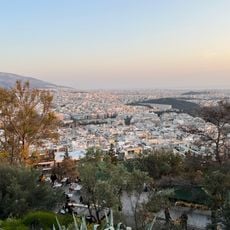
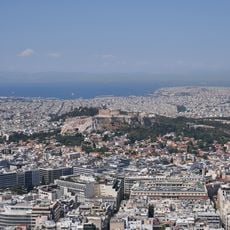
Mount Lycabettus, Limestone hill in Athens, Greece.
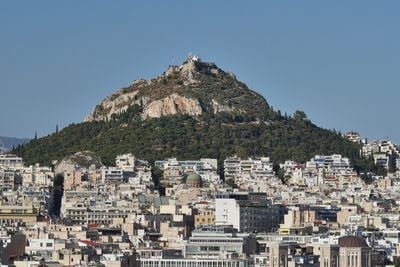
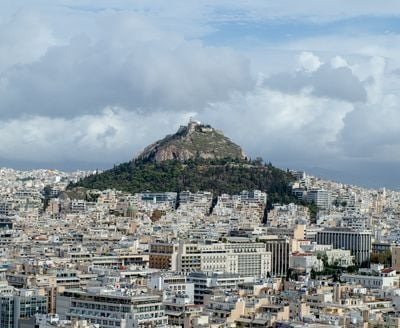
Mount Lycabettus is a Cretaceous limestone hill rising 277 meters above sea level, the highest point in central Athens. Pine trees cover its base, while pale grey and tan cliffs crown the summit, where the white Chapel of St. George, a theatre and a restaurant stand. The hill rises directly behind the city buildings of Kolonaki.
Lycabettus appears in myths as a limestone rock Athena dropped after a crow brought bad news; the myth says crows turned black from that moment. The hill was used as an open-air theatre under the 4th of August Regime, and on 7 August 1939 Takis Mouzenidis directed Kleist's Penthesilea there for the EON and the Royal Theatre.
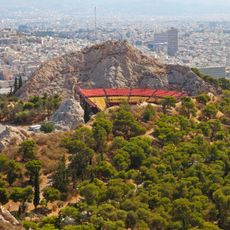
The hill's name is linked to the Greek word for wolf (lykos), from the story that wolves once lived on its slopes; another etymology traces it to a Pelasgian term for a mastoid hill. The open-air theatre near the top hosted its first performance on 7 August 1939, Kleist's Penthesilea directed by Takis Mouzenidis, and after a 15-year closure it reopened in September 2023.
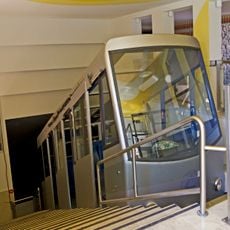
The Lycabettus Funicular climbs from its lower terminus on Aristippou Street in Kolonaki to the summit. The hill rises 277 metres above sea level, 227 metres above the city. A theatre, a restaurant and the Chapel of St. George stand at the top.
An outdoor theater carved into the slope has hosted performances by international artists such as Ray Charles and Bob Dylan over the years. The shape of the theater uses the natural acoustics of the rock face and offers views over the city during events.
The community of curious travelers
AroundUs brings together thousands of curated places, local tips, and hidden gems, enriched daily by 92,661 contributors worldwide.