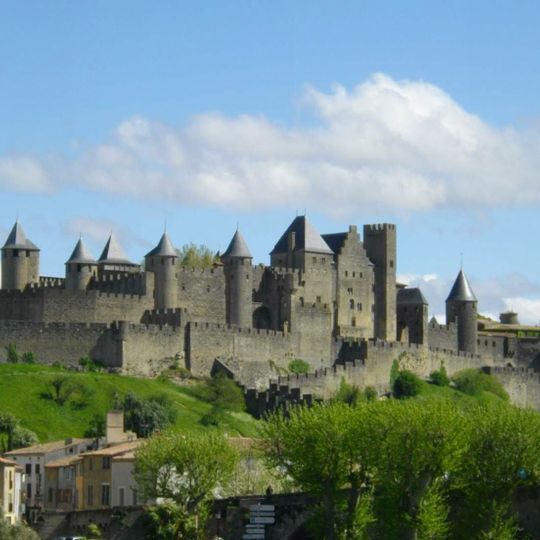
Cité de Carcassonne, Medieval fortress in Carcassonne, France
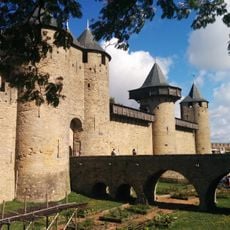
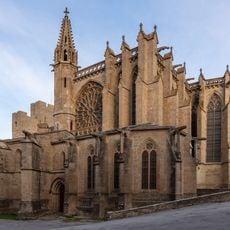
The Cité de Carcassonne is a walled medieval town on a hill above the Aude River in southern France. Two concentric stone walls enclose a maze of cobbled lanes, a Romanesque basilica, and the central castle of the counts with its own defenses and a rectangular courtyard.
A Gaulish oppidum called Carsac stood here before the Romans turned the site into a fortified town in the 3rd century CE; the defences were in place by 333, when texts call the place a castellum. The Visigoths rebuilt the walls in the 5th and 6th centuries. After the Albigensian Crusade and the 1247 annexation to the French crown, the inner Roman walls were largely demolished and replaced, and an outer line was added, continued under Philip IV.
The name goes back to Carsac, an oppidum recorded in the 6th century BC, which the Romans later called Carcaso; the town was capital of the colonia Julia Carcaso. The outer wall's passage between the two rings, the lices, now serves as a walking route through the citadel.
The entrance is on the west side of the complex, and visitors can walk along the ramparts and through the lanes without a guide. The paths between the two rings of walls are mostly unpaved and can get slippery when wet, so sturdy shoes help.
During restoration work in the 19th century, architect Eugène Viollet-le-Duc added pointed slate roofs to the towers, even though the medieval towers had flat roofs. The silhouette visible today with its characteristic roofs reflects a romantic vision of the Middle Ages rather than the original construction.
The community of curious travelers
AroundUs brings together thousands of curated places, local tips, and hidden gems, enriched daily by 92,722 contributors worldwide.