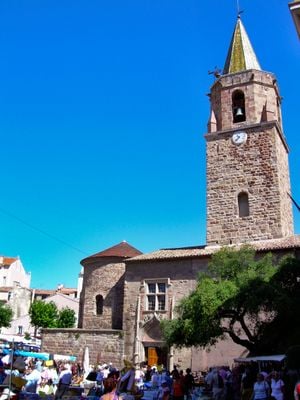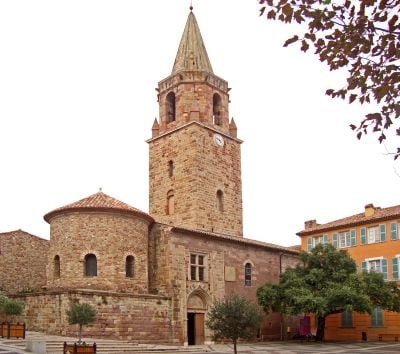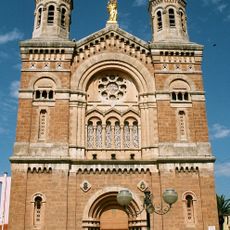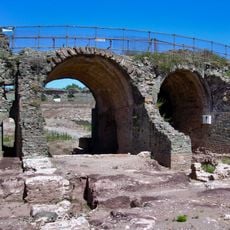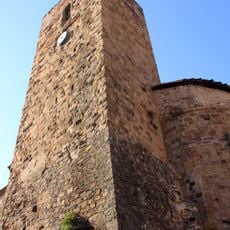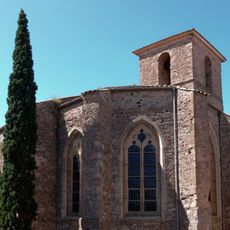
Fréjus Cathedral, Gothic cathedral in Fréjus, France.
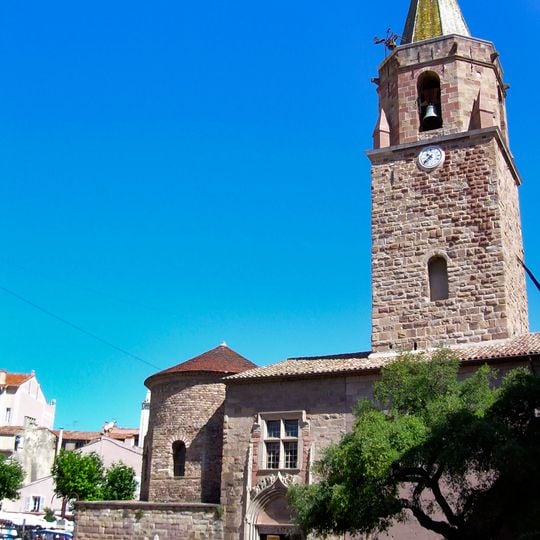
Fréjus Cathedral is a medieval complex of buildings from the 5th to 13th centuries, with two adjoining naves under one roof: Notre-Dame and Saint-Étienne. Its 13th-century square bell tower rises above the narthex, topped by a 16th-century octagonal drum and a conical roof painted yellow and green. The Romanesque cloister has two levels, with arcades on paired columns and painted wooden ceiling panels.
The cathedral was traditionally founded by Saint Leontius, bishop of Fréjus (c. 419–c. 488), and was the seat of the Bishop of Fréjus from the 5th century. The diocese was abolished in 1801, restored in 1822, and in 1957 united with Toulon; Fréjus has since been a co-cathedral. The 13th century brought a bell tower and porch on the west front, a new chevet and a chapter hall.
The site holds two distinct churches in one structure: Saint Stephen's served the parish while Notre-Dame was reserved for the bishop's functions. This physical separation reflects the different roles the complex played in the community's religious life.
The cloister is entered from rue Fleury, on the cathedral's north-east side, not through the nave; the room right of the entrance holds the municipal archaeology museum. The old well at its centre and the double stair to the upper floor were restored between 1922 and 1931. The baptistery lies south-west of the cathedral.
The baptistery's lower exterior is a square about eleven metres to a side, topped by a domed octagonal structure. Its eight corner columns are Corinthian capitals reused from a Roman building, and the octagonal immersion pool inside was rediscovered in 1925 by architect Jules Formigé.
The community of curious travelers
AroundUs brings together thousands of curated places, local tips, and hidden gems, enriched daily by 93,645 contributors worldwide.