Missiri mosque, Military mosque and community center in Fréjus, France
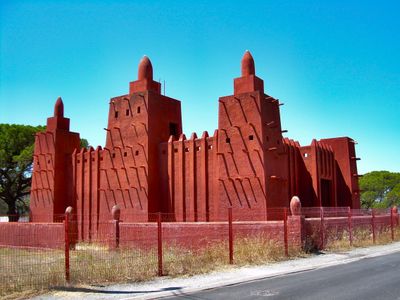
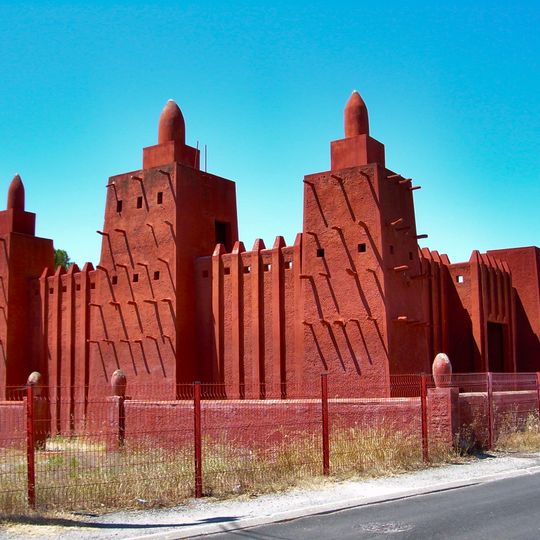
The Missiri mosque stands on the outskirts of Fréjus in the former Caïs military camp. Built of cement agglomerates and covered in ochre-red plaster to evoke the earthen Great Mosque of Djenné in Mali, it has a broad flat-topped facade divided by tall vertical buttresses, two main tower sections topped with rounded conical finials, and smaller finials along the lower roofline. The building is roofless and its wall murals remain unfinished.
The Missiri mosque was built between 1928 and 1930 in the Caïs military camp on the road to Bagnols-en-Forêt, on the initiative of Captain Abdel Kader Mademba, supported by Colonel Lame. It was intended as a community centre for the Senegalese Tirailleurs, comparable to the Hông Hiên Tu pagoda built by the Indochinese tirailleurs in 1917. It was listed in the supplementary inventory of historic monuments on 18 June 1987.
The name Missiri comes from the Bambara language and reflects the bond between French military forces and West African colonial troops. The building served as a gathering place where soldiers maintained their cultural practices and community traditions.
The building stands on the outskirts of Fréjus, in the former military camp of Caïs, on the road to Bagnols-en-Forêt. It belongs to the Ministry of Armed Forces, and the museum of the Troupes de Marine in Fréjus is in charge of its preservation. The structure has no roof and its murals are unfinished, so plan for open-air conditions.
The building is a cement copy of the Great Mosque of Djenné in Mali, coated in ochre to imitate the original's earth construction. A second replica was built in the Bois de Vincennes for the 1931 Paris Colonial Exposition and demolished soon after the exhibition closed.
The community of curious travelers
AroundUs brings together thousands of curated places, local tips, and hidden gems, enriched daily by 94,115 contributors worldwide.