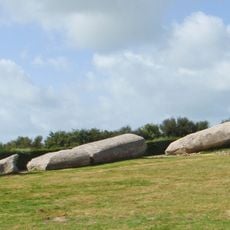
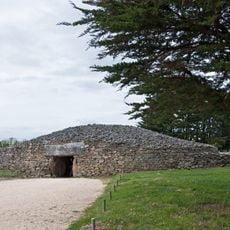
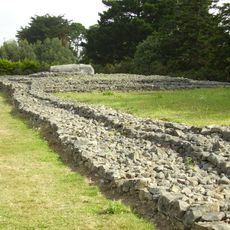
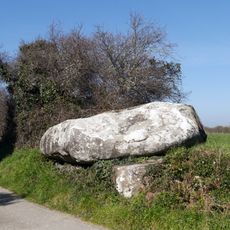
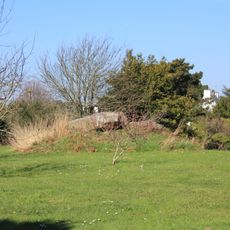
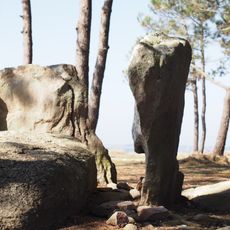
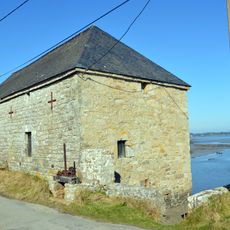
Tumulus du Mané-Lud, Neolithic burial mound in Locmariaquer, France
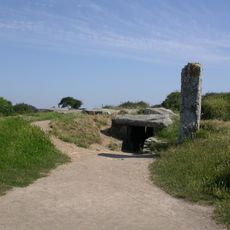
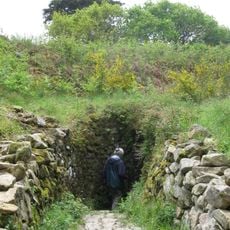
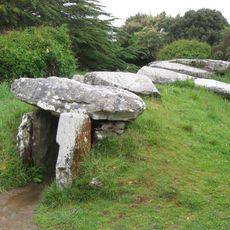
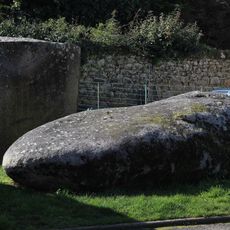
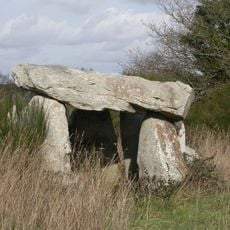
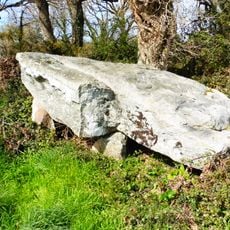
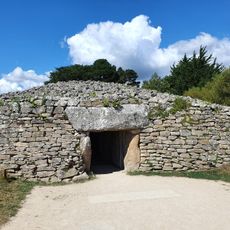
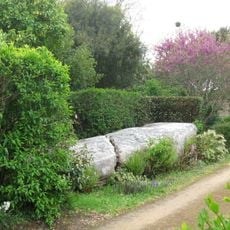
The Mané-Lud tumulus is an 80-metre-long earthen mound at Locmariaquer, covering a passage dolmen entered from the south. Its corridor, about 10 metres long, leads to a chamber roughly 4 by 3 metres whose floor is a single reused orthogneiss menhir; the ceiling slabs include one 8.30 metres long. Many orthogneiss wall stones carry carvings of boats, axes, crooks and a figure interpreted as a whale.
The mound was built during the Neolithic period as a burial place for multiple individuals. Excavations in the 1800s revealed remains and artifacts that confirmed the great age of the structure.
The carvings on the orthogneiss slabs have been read in different ways since 1863: as yokes, axes, boats, birds, croziers and, for the head slab, a blowing sperm whale according to Serge Cassen. The granite stones are left plain, so the decorated slabs stand out. The Breton name Mané-Lud likely derives from Mané (hill) and Uhelan (very high).
The passage opens to the south, but a modern building partly blocks the entrance, so the approach is narrow. The chamber floor is a single ogive-shaped slab, and the corridor floor is uneven packed earth with loose stones. Headroom rises from the entrance to about 1.7 m under the chamber slabs. The mound sits at the northern edge of Locmariaquer, about 130 m north of the Er Grah tumulus and west of the RD781.
The structure combines two different burial systems under one large earthen mound: a sealed chamber without a corridor and a passage tomb. This combination of two burial types in one location is unusual and reveals how burial practices may have evolved.
The community of curious travelers
AroundUs brings together thousands of curated places, local tips, and hidden gems, enriched daily by 93,768 contributors worldwide.