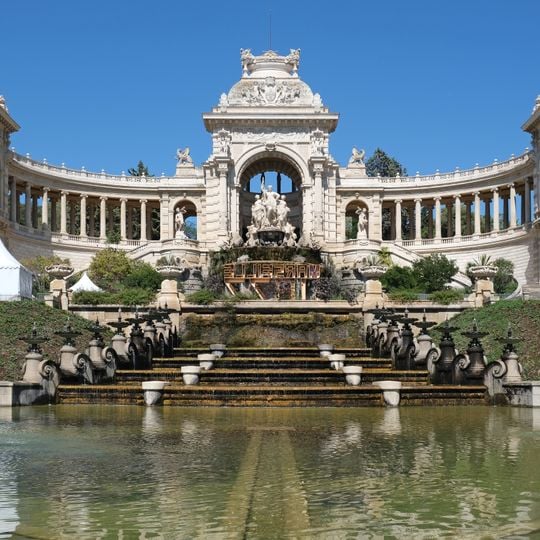
Palais Longchamp, Water tower and museum complex in 4th district, France
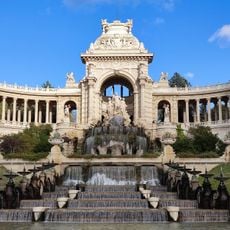
Palais Longchamp is a 19th-century monument in Marseille's 4th arrondissement, centered on a château d'eau with a tall arched opening, a rounded crown bearing carved figures, and a tiered cascade descending to a pool. A shallow curved colonnade of repeated columns sweeps outward to lower end pavilions. The east wing houses the Musée des Beaux-Arts and the west wing the Muséum d'histoire naturelle.
The first stone was laid on 15 November 1839 by the Duke of Orleans, but the palace was not inaugurated until 1869. The delay came from the cost and from successive abandoned projects, including one by Auguste Bartholdi, before Henri-Jacques Espérandieu was chosen in 1861. It was built to celebrate the Canal de Marseille, which carried Durance water 85 km to the city.
The palace's name comes from the Longchamp plateau, and its water tower celebrates the Durance, represented by a central female figure flanked by allegories of grapes and wheat. The park behind holds a garden à la française and an English landscape garden with a 150-year-old plane tree. Since 2013, animal sculptures have replaced the animals of the former zoo.
The outdoor grounds are freely accessible at all times for a full view of the architecture and fountains, while the museum interiors operate on specific visiting days. Check opening times before planning your visit to see the indoor collections.
Auguste Bartholdi, later sculptor of the Statue of Liberty, proposed a water tower for this site in 1859 and claimed the semicircular colonnade as his own idea. The city paid his fees but chose Henri Espérandieu's design; Bartholdi lost his court cases, including an appeal at Aix that ended in a fine.
The community of curious travelers
AroundUs brings together thousands of curated places, local tips, and hidden gems, enriched daily by 94,039 contributors worldwide.