Château de Lissieu, Medieval castle in Lissieu, France
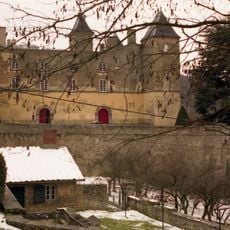
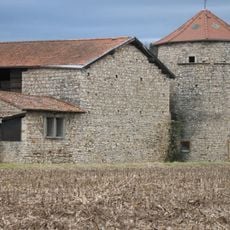
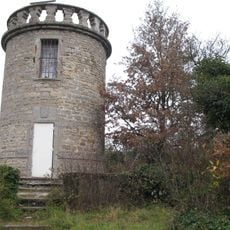
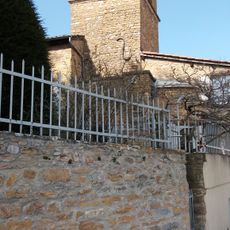
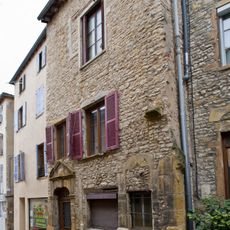
Château de Lissieu is a former fortified castle in the centre of Lissieu. Its surviving medieval parts are a cylindrical keep, a dwelling and a gate with a brattice, framed by two round towers; the main gate was rebuilt at the end of the 16th century. The walls are built of local stone, yellow with an orange tinge and faded by age. The gate and the great tower were separately listed in 1936.
The castle belonged to the lords of Beaujeu from the 12th century, a claim contested by the Church of Lyon; in 1132 Pope Innocent II ordered its demolition, still unexecuted in 1143. In 1298 Guichard VI d'Albon-Forez ceded the seigneurie to Archbishop Henri de Villars. In 1591 Huguenots blew up the main gate, which was rebuilt at the end of the 16th century.
The name Lissieu passed from the Beaujeu lords to the Villars archbishops in 1298, then through the Lambert family to the d'Arces around the mid-16th century. A banner reading "Marie" hangs above the gate, recalling Marie Athiaud, who brought the fief to the Boissat family by her marriage around 1593.
The castle stands at 2 Place des Tours in Lissieu, with certain sections owned by private parties that restrict general public access. It is advisable to check ahead about accessibility and respect the boundaries of the property.
In 1591 the castle came under attack from Huguenot forces, who destroyed its main gate in an explosion. The gate was later rebuilt and still stands today as evidence of these conflicts.
The community of curious travelers
AroundUs brings together thousands of curated places, local tips, and hidden gems, enriched daily by 94,281 contributors worldwide.