Raymonden, Prehistoric cave in Chancelade, France
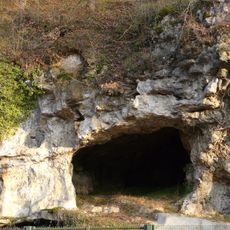
Raymonden is a cave on the left bank of the Beauronne, about one kilometre north of Chancelade. Its entrance sits between two former quarries in flat-lying Angoumian limestone, close to the D 939 road. The archaeological deposit in front of the cave is 1.35 metres thick and was divided into four ash layers.
Discovered in 1876 by M. Hardy, the site was first excavated by him and, from 1883, by two Périgueux college teachers. In 1887 railway construction workers mistakenly used the deposits in front of the cave as track gravel, scattering artefacts over nearly a kilometre. Hardy and M. Féaux then studied the site systematically until 1888, finding a tomb with human remains at the base of the archaeological layer.
The site's best-known artwork is the bison plate, a decorated stone plaquette from the Magdalenian. The bone tools are mostly reindeer bone, and saiga antelope appears in Magdalenian II, while seal bones occur in Magdalenian VI. The Chancelade Man was buried with red ochre, which stained his bones.
The cave sits about one kilometre north of Chancelade, on the left bank of the Beauronne, wedged between two old quarries near the hamlet of les Grèzes; the D 939 from Périgueux to Brantôme runs directly in front of it. The ground in front of the entrance was flooded occasionally, so plan around wet weather.
Railroad workers in the 1800s unknowingly extracted sediment from the cave to use as construction material, mixing up the archaeological layers. This accidental disturbance makes it challenging today to understand exactly where and when certain objects were deposited.
The community of curious travelers
AroundUs brings together thousands of curated places, local tips, and hidden gems, enriched daily by 93,465 contributors worldwide.