Église Saint-Étienne-de-la-Cité, Romanesque church in Périgueux, France
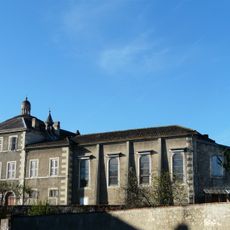
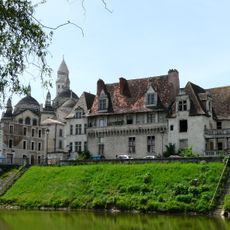
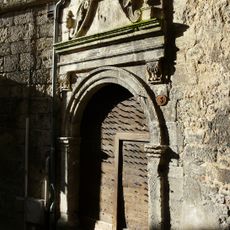
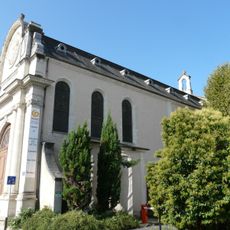
Église Saint-Étienne-de-la-Cité is a Romanesque church in Périgueux, built from the 11th to the 12th century. It has a grey dome with a lantern, and its light grey and beige stone walls show weathered patches. The west front has three tall arched windows above a wooden double door with a carved cross, and two smaller arched doors at ground level.
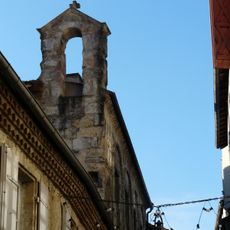
A first church was built on the site of a temple of Mars in the early 6th century under Bishop Chronope II. Construction of the Romanesque church began in the 11th century with the western bay and ended in the 12th with the choir. In 1577 Huguenots burned and destroyed half the building, including two western bays and the bell tower; the tower was restored in 1620. The episcopal seat moved to Saint-Front in 1669, and Saint-Étienne became a simple parish church.
The Easter table is a carved stone plaque listing the dates of Easter, moved here from the south wall of the old cathedral's altar room. The 12th-century tomb is that of Jean d'Asside, bishop of Périgueux. A 17th-century oak and walnut altarpiece from the former Jesuit college now stands under the western dome.
You can visit during daylight hours, but check ahead for exact opening times since they vary by season. Contact the Périgueux Tourist Office in advance if you want a guided tour or more detailed information.
The tribune organ was built by Marin Carouge in the 18th century and moved here around 1885 after Merklin replaced it at Saint-Front. Bartholoméo Formentelli rebuilt it between 1990 and 1993, supported by the Association des amis de l'orgue de la Cité, then chaired by Xavier Darcos; Michel Chapuis inaugurated it. The case and instrument were listed as monuments historiques in 1976.
The community of curious travelers
AroundUs brings together thousands of curated places, local tips, and hidden gems, enriched daily by 93,149 contributors worldwide.