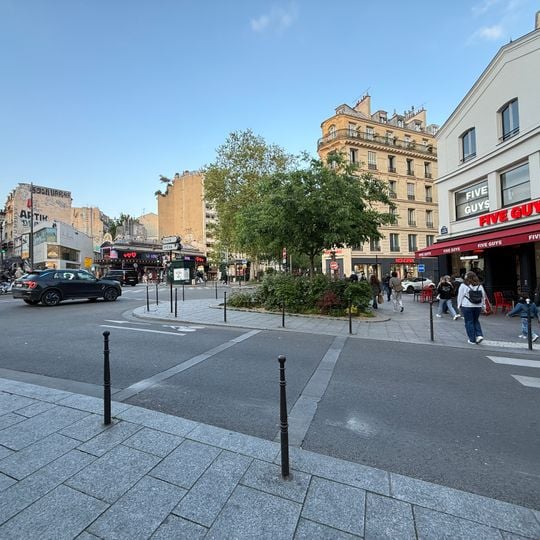
Place Blanche, Square in the 9th arrondissement, Paris
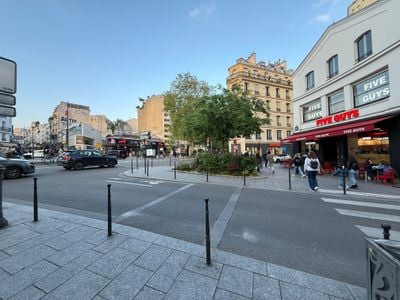
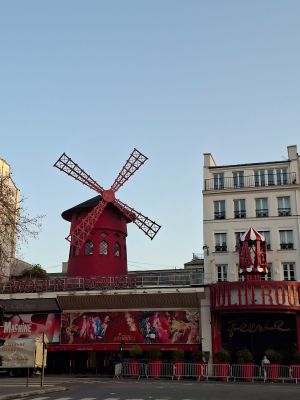
Place Blanche is a small oval square in the 9th arrondissement of Paris, in the Quartier Saint-Georges, sitting at the junction of Rue Fontaine, Rue Blanche, and Boulevard de Clichy. The Moulin Rouge cabaret stands right on the square, its red windmill on the roof visible from a distance.
The square was laid out by ministerial order in 1802, on a site begun in 1789, with a radius of 30 metres. On 23 May 1871, during the Bloody Week of the Paris Commune, 120 communard women defended a barricade here against General Clinchant's Versailles troops before retreating to Place Pigalle; those who could not retreat, including Blanche Lefebvre, were executed on the spot.
The name comes from the former barrière Blanche, itself named after the barrière de la Croix Blanche that stood here. The square appears in French song: Fréhel asks "Où est-il mon moulin d'la place Blanche?" in Où est-il donc?, and Dutronc sings of it in Il est cinq heures, Paris s'éveille.
The closest Metro station is Blanche on line 2, right at the square, making it easy to arrive and leave without getting lost. From the square, you can walk up into Montmartre, though some parts of the route involve steep streets.
In the 1950s, Swedish photographer Christer Strömholm spent years documenting the lives of transsexual women who lived around the square, resulting in the book Les Amies de Place Blanche. It is considered one of the earliest and most personal photographic records of that community in Europe.
The community of curious travelers
AroundUs brings together thousands of curated places, local tips, and hidden gems, enriched daily by 94,657 contributors worldwide.