Calanque de Port-Miou, Limestone cliffs and marina in Cassis, France
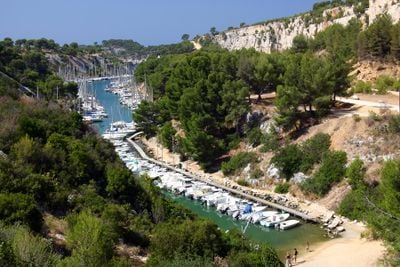
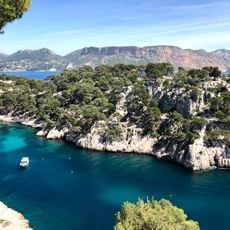
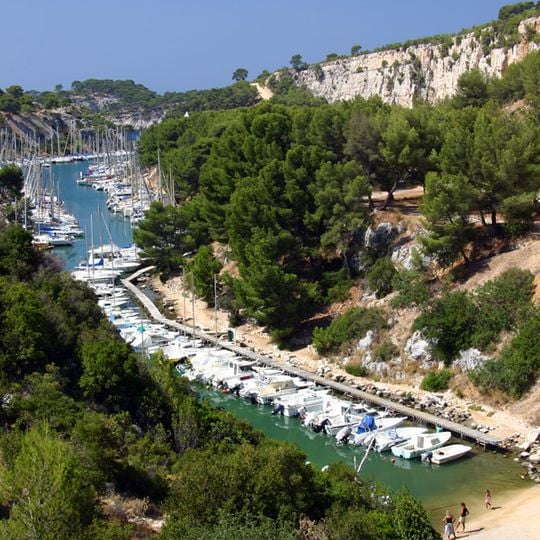
Calanque de Port-Miou is a long, narrow inlet bounded by steep white limestone cliffs and featuring a sheltered natural harbor. The waterway penetrates deep into the land and can accommodate several hundred small boats in its protected basin.
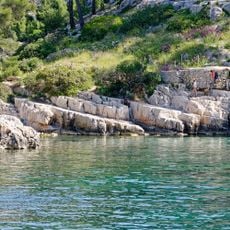
Port-Miou was long a seigniory of its own, held by the House of Baux. On 4 April 1402 at Brantes, Odon de Villars gave his nephew Philippe de Lévis the seigneuries of Cassis and Port-Miou, among others, with a 50,000-florin surety pledged to Raymond de Turenne. The inlet's limestone was quarried not for building stone but for the Solvay caustic-soda process, crushed on site and shipped to Salin-de-Giraud until 1982.
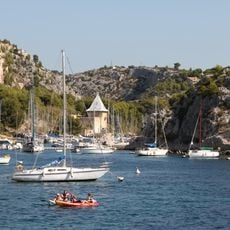
The name Port-Miou transcribes the Occitan Pòrt-Melhor, "best port", pronounced locally /pwɔʁ.mi.ju/. The left bank belongs to the town of Cassis and the right bank to the Solvay company; the small château that once housed the quarry miners now serves as the marina's capitainerie.
Access is by road; a car park lets boat owners leave vehicles and reach their boats. The site has no beach, but it is the starting point for hikes in the Calanques massif. Two banks have pontoons for pleasure boats, and the small castle in the middle of the bank by the former quarry houses the marina office.
The submarine spring of Port-Miou, the exsurgence, discharges 5 to 7 cubic metres per second into the inlet, making it the largest underground river flowing in Provence between the Rhône and the Var. Its origin is still unknown. The spring feeds the dark greenish water where the white boats are moored.
The community of curious travelers
AroundUs brings together thousands of curated places, local tips, and hidden gems, enriched daily by 94,039 contributors worldwide.