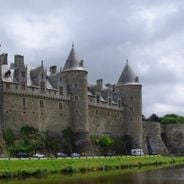
Château de Cheffontaines, 18th century castle in Clohars-Fouesnant, France.
Château de Cheffontaines stands in Clohars-Fouesnant, Finistère, built on the simple malouinière plan but flanked by two large pavilions, themselves supported by two small pavilions housing the chapel and the library. The long grey stone facade has two storeys of white-framed windows, a band of grey stone between them, and central double doors under a rounded arch; tall stone chimneys and a pyramidal roof section with dormer openings rise from the dark slate roof.
Seized as a national asset during the Revolution, the château was sold to Paul Célarier Damiguet de Vernon, then passed to Aimé-Désiré Calloch de Kérillis, mayor of Clohars-Fouesnant from 1821 to 1823. In 1834 Étienne Le Bourhis obtained permission to install a Prussian blue factory there. The Penfentenyo family bought the château back in 1860.
The Penfentenyo family, marquises of Cheffontaines, kept a wolf-hunting pack whose abandonment when they emigrated gave rise to the local saying "Hurler comme les chiens de Cheffontaines" (to howl like the dogs of Cheffontaines), long used in Clohars-Fouesnant. The family bought the château back in 1860.
The castle stands in Clohars-Fouesnant, in Finistère. The building is a listed monument and the park, laid out at the end of the 18th century with its pond, is recorded in the pre-inventory of remarkable gardens. The 1.7 km beech avenue in front of the castle was cut down during the Second World War for a landing strip that was never used; beeches were replanted in the early 1950s.
The 1.7 km beech avenue in front of the castle was cut down during World War II to clear a landing strip for German aircraft, but the runway was never used. Beeches were replanted in the early 1950s.
The community of curious travelers
AroundUs brings together thousands of curated places, local tips, and hidden gems, enriched daily by 94,111 contributors worldwide.