Ancient Roman circus of Lyon, Roman circus (unlocated) in Lyon, France
The ancient Roman circus of Lyon has left no visible remains; its existence is proven by three inscriptions, and its location is still debated. A mosaic of chariot races in the Gallo-Roman Museum may depict it, with a central barrier formed by water basins. Possible sites include the Fourvière plateau and the Trion ditch.
Three inscriptions prove the circus existed, though no remains have been identified. A lost stone block from Bellecour records that the aedile Sextus Julius Januarius provided 500 seats. Another, found in 1824 at Saint-Irénée, shows the centonarii (rag dealers) restored seats under Marcus Aurelius or Septimius Severus. A third mentions games given by the quaestor and duumvir Sextus Ligurius Marinus.
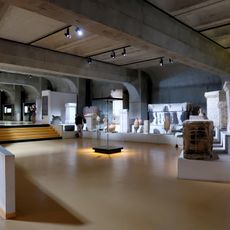
The mosaic of the Games of the Circus, kept at the Museum of Gallo-Roman Civilization, may show this monument: its spina is formed of water basins, which would tie the circus to the Gier aqueduct. Three inscriptions prove the building existed, including one recording 500 seats arranged by the aedile Sextus Julius Januarius.
No remains of the circus have been identified, so there is no site to walk through; the evidence is three inscriptions and the mosaic of the circus games in the Museum of Gallo-Roman Civilization at Fourvière. The debated locations lie on the Fourvière plateau and in the Trion ditch, areas that are largely built over or occupied by the Loyasse cemetery and hard to excavate.
No trace of the circus has ever been found: archaeologist Amable Audin (1899-1990) suggested it was a timber structure that decayed, which would explain the absence of visible remains. The mosaic of the circus games in the Museum of Gallo-Roman Civilization may show its barrier formed by water basins, fed by the Gier aqueduct.
The community of curious travelers
AroundUs brings together thousands of curated places, local tips, and hidden gems, enriched daily by 92,751 contributors worldwide.