Fanum d'Aron, Romano-Celtic temple in Aurillac, France
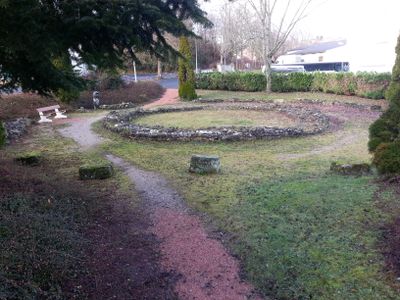
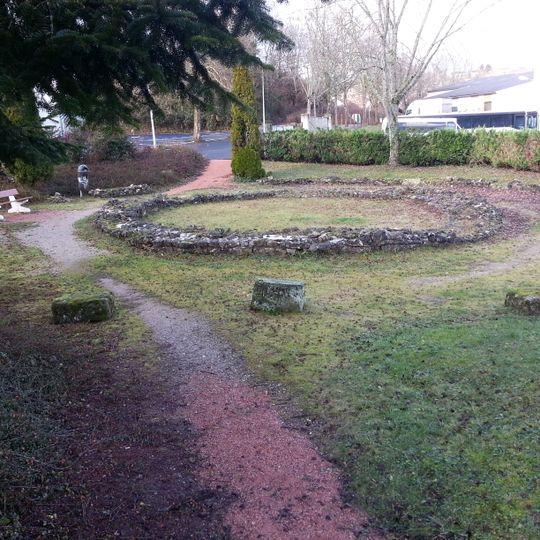
Fanum d'Aron is a Romano-Celtic temple whose circular cella, about 8.5 m across inside, is ringed by a sixteen-sided gallery just over 3.2 m wide, paved with flat stones. Eight fluted columns with Corinthian capitals stood at the angles; the walls mix limestone and trachy-andesite. Today only low, broken courses of dark stone outline the plan in a grassy municipal garden.
The temple was probably built in the mid-1st century CE and abandoned or destroyed in the 3rd or 4th century. Roman remains such as tiles, pottery sherds and column fragments surfaced in the early 1970s; the temple itself was found in May 1977 during earthworks for an industrial zone, and rescue excavation ran until 1983. It was listed as a monument historique in 1980.
The name "Aron" is not a recorded Roman or Celtic deity; the sources give no explanation of its origin. The site name Lescudillier, from the local term for a bowl merchant, likely refers to the many ancient pottery sherds found here. Votive objects recovered include animal bones and teeth, some deliberately mutilated.
The site sits in a small municipal garden at a moderate altitude surrounded by homes and is easily accessible on foot. You can walk around the exposed ruins without barriers and see the remains clearly.
The columns feature grooved shafts topped with ornate Corinthian capitals decorated in acanthus leaf designs. This refined decoration was uncommon for temples in the outer regions of the Roman realm.
The community of curious travelers
AroundUs brings together thousands of curated places, local tips, and hidden gems, enriched daily by 92,892 contributors worldwide.