Hôtel Montescot, Private mansion in Chartres, France
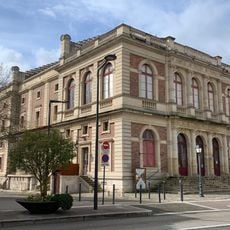
Hôtel Montescot is a 17th-century mansion set between a square courtyard and a garden, with a main building and two return wings of three levels each. The street side is closed by a wall pierced by a monumental portal: a round-arched doorway of alternating brick and stone voussoirs, flanked by engaged Doric columns and topped by a scrolled pediment with a coat of arms. Behind the central door rises a ramped staircase vaulted in brick and stone.
Jean de Montescot, administrator of the Duchy of Chartres, commissioned the original building in 1546. Badly damaged in the French Wars of Religion, it was rebuilt in the neoclassical style by his son Claude de Montescot and completed in 1614. After Claude's death in 1625 his son Jacques sold it to the Ursulines of Saumur, who turned it into a school for poor girls; the Daughters of Providence ran an orphanage here from 1761. Seized by the state in 1792, it was bought by the City of Chartres in 1824 for use as a town hall.
The name recalls Claude de Montescot, who built the mansion in the 1610s; his bust, framed by two winged figures within a brick arch, crowns the central courtyard doorway. The Ursulines turned the house into a school for poor girls in 1625, and the Daughters of Providence ran an orphanage here from 1761.
The building now serves as Chartres City Hall with administrative offices and ceremonial spaces for municipal functions and weddings. Access may be restricted since it remains an active government seat with regular operations.
The bust above the courtyard's central doorway depicts Henry IV, framed by two winged figures seated on scrolls within a semicircular panel. The same scheme repeats on the street portal, where a carved coat of arms sits between the volutes of a broken curved pediment.
The community of curious travelers
AroundUs brings together thousands of curated places, local tips, and hidden gems, enriched daily by 94,537 contributors worldwide.