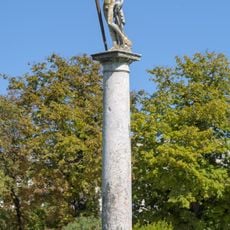
Le Cri, l'Écrit, Bronze sculpture in Luxembourg Garden, Paris, France
Le Cri, l'Écrit is a 3.70-metre bronze sculpture by Fabrice Hyber, made of three rings: the lower one for roots, the middle one for the continuing possibility of slavery, and the open upper one for abolition. One face is dark and convex, bearing words from the vocabulary of slavery; the other is flat, white, with painted red and green veins.
The work was created in 2007 by French artist Fabrice Hyber and installed in the Luxembourg Garden. It was produced during a period when France was integrating the abolition of slavery in its colonies more prominently into public discourse.
The work's title plays on the cry and the written word: Hyber said the cry marks abolition but also warns against modern slavery, and that a written work was needed for a garden facing the Senate. Each 10 May, the national day of remembrance of slavery and its abolition, an official ceremony is held here with the President of the Republic or the Prime Minister.
The sculpture sits in a central area of the Luxembourg Garden and is easy to reach on foot since it sits along the main pathways. An informative plaque explains the work's meaning, so it is best to visit without time pressure to read everything at leisure.
The sculpture has two faces: one is convex and dark, bearing words from the vocabulary of slavery; the other is flat, with red and green veins painted on a white background. The artist, Fabrice Hyber, described the open ring as abolition and the closed ring as the risk that everything could start again.
The community of curious travelers
AroundUs brings together thousands of curated places, local tips, and hidden gems, enriched daily by 92,855 contributors worldwide.