Mausoleum of Glanum, Roman funerary monument in Saint-Rémy-de-Provence, France
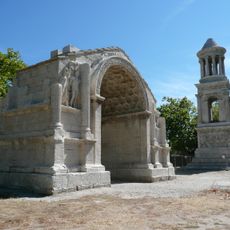
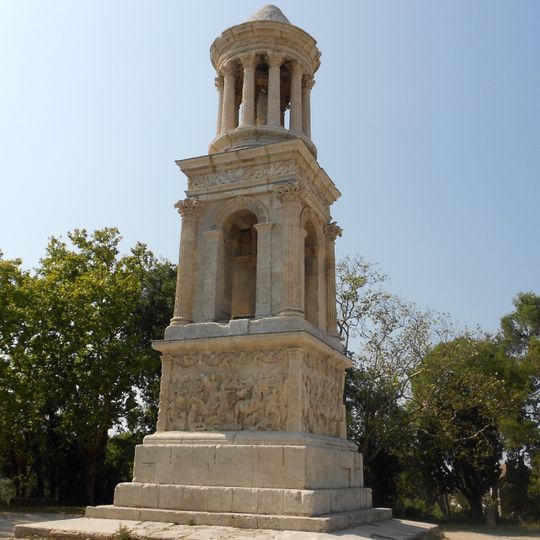
The Mausoleum of Glanum is a Gallo-Roman funerary monument built between 30 and 20 BC, standing south of Saint-Rémy-de-Provence. It rises 16 metres in three tiers: a carved cubic base, a four-arched tetrapyle, and a circular colonnade (tholos) with a conical roof. The base reliefs show the Amazonomachy, the Calydonian boar hunt, the Trojan War, and a battle scene.
The monument was erected between 30 and 20 BC, during the principate of Augustus, after the pomerium of Glanum and a few hundred metres north of the town's archaeological excavations. Its inscription names Sextus, Marcus and Lucius, sons of Caius Julius, who dedicated it to their parents; the family's nomen Julius shows a Gaulish ancestor had gained Roman citizenship through army service, probably under Caesar. It was listed as a monument historique in 1840.
The name of the family honored here, the Iulii, appears in a carved inscription that visitors can still read on the stone today. The relief panels around the base show battle scenes and processions that give a direct sense of how Roman families displayed their status and memory.
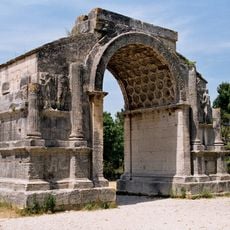
The mausoleum stands just beside a Roman arch at the entrance to the Glanum site, and both monuments are visible from the road without entering the paid area. Morning light works best for seeing the carved reliefs, as the sun hits the stone directly at that time of day.
The monument contains no burial chamber: it was built as a cenotaph, meaning it honors the dead without actually containing their remains. The actual graves of the Iulii family were likely located elsewhere near the ancient town.
The community of curious travelers
AroundUs brings together thousands of curated places, local tips, and hidden gems, enriched daily by 92,895 contributors worldwide.