Palais Universitaire, Strasbourg, University palace in Strasbourg, France
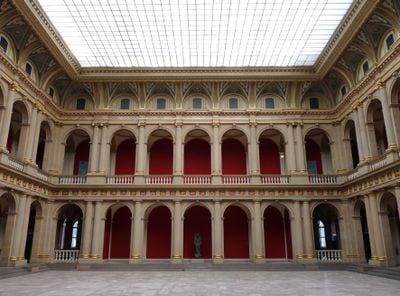
The Palais Universitaire is a neo-Renaissance building erected between 1879 and 1884 by architect Otto Warth, modelled on Michele Sanmicheli's Palazzo Pompei in Verona. Its grooved ground floor and pilaster-framed round-arched windows carry 36 statues of scholars, mostly of Germanic origin, and the balustrade reads LITTERIS ET PATRIAE. Inside, the Aula is a glass-roofed courtyard 25 by 29 metres and 16 metres high, with a painted arch frieze and a seated black granite statue of Ramses II.
The building was constructed between 1879 and 1884 under architect Otto Warth and replaced an earlier academic institution from the 16th century. Its construction marked a turning point in the university's development as a major educational center.
The Aula, a glass-roofed courtyard, was dedicated to Marc Bloch in 2012; the historian was a professor at the university and was shot by the Nazis in 1944. The basement holds the Gypsothèque, a plaster cast museum, and the Presses Universitaires de Strasbourg, founded in 1920 and described as the oldest university press in France, has its headquarters in the building.
The Aula, the entrance hall and the main stairways are classified as monuments historiques, so they are the parts to look for; the Aula was dedicated to Marc Bloch in 2012. The building still houses the arts, historical sciences and theology faculties, so teaching areas may be closed during term time. The Gypsothèque plaster cast museum is in the basement.
The building hosted the first Council of Europe session in 1949, when 101 delegates from twelve European nations gathered together. This historic meeting made it a symbol of early efforts toward European cooperation.
The community of curious travelers
AroundUs brings together thousands of curated places, local tips, and hidden gems, enriched daily by 92,805 contributors worldwide.