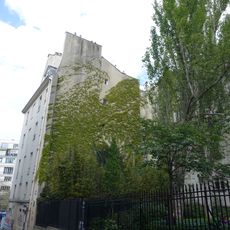
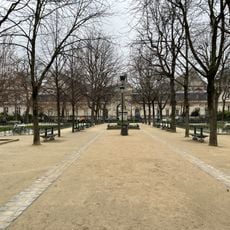
Passage Sainte-Foy, Passageway in the 2nd arrondissement, Paris, France
Passage Sainte-Foy is a straight 78-metre passageway in the 2nd arrondissement, running east-west between rue Saint-Denis and rue Sainte-Foy, entered through building doors at both ends. It crosses the buildings in a straight line, then bends slightly north at its rue Sainte-Foy exit. A staircase of thirteen steps marks the level difference between the inner walkway and the earth bank of the former Charles V wall, whose top rue Sainte-Foy occupied.
The passage was built in 1813 under the name Passage Aubert and renamed in 1873 to its current designation. This change reflects how covered walkways in Paris evolved and were renamed as the city developed during the 19th century.
The name comes from the neighbouring rue Sainte-Foy, itself named after the sign of an old shop there that showed Saint Faith. The passage took its present name in 1873, having been rebuilt in 1813 as the passage Aubert on the line of the former passage Sainte-Marguerite.
The passage runs east-west for 78 metres, entered through building doors on both rue Saint-Denis and rue Sainte-Foy. A staircase of 13 steps inside handles the level difference left by the former Charles V rampart. The exit onto rue Sainte-Foy bends slightly north, so look for the doorway rather than a continuous open street.
Just before its exit at rue Sainte-Foy, this corridor shifts slightly northward, deviating from its otherwise straight path. This subtle bend reveals an unexpected spatial complexity in what appears to be a simple rectangular passageway.
The community of curious travelers
AroundUs brings together thousands of curated places, local tips, and hidden gems, enriched daily by 93,036 contributors worldwide.