Tour de l'Horloge, Medieval clock tower at Palais de la Cité, France
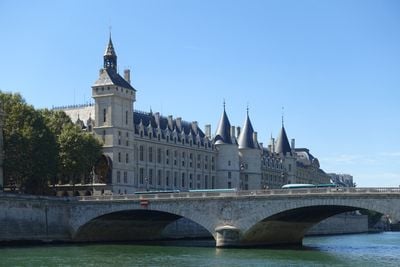
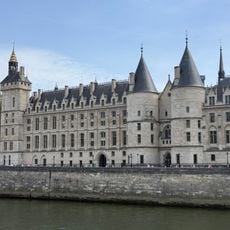
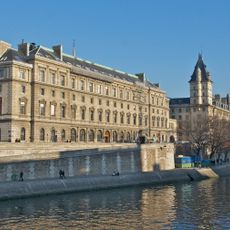
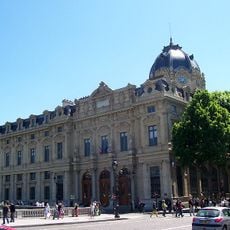
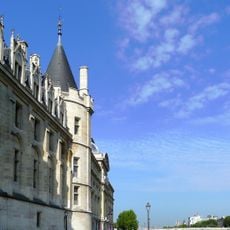
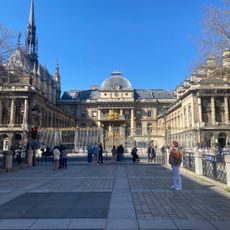
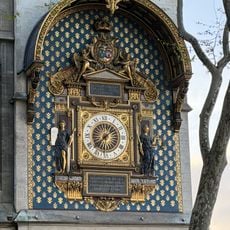
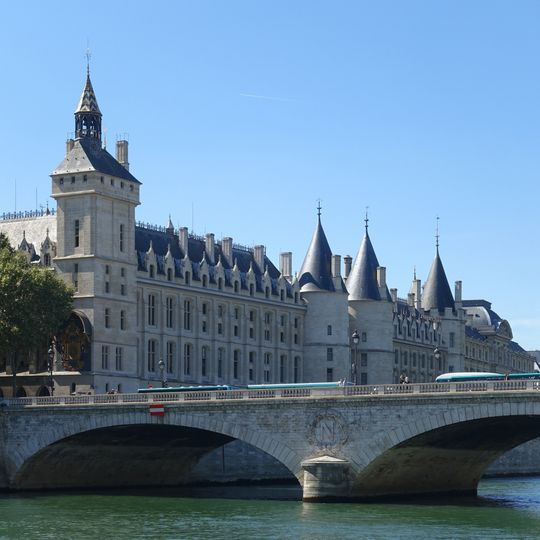
The Tour de l'Horloge is a rectangular stone tower 47 metres high at the north-east corner of the Palais de la Cité, with walls nearly a metre thick. Its square dial, about 1.5 metres across, shows gilded rays on an azure field strewn with fleurs-de-lis, framed by figures of Law and Justice. An open lantern with a zigzag-patterned conical cap tops the steep roof.
The tower was built between 1350 and 1353 under King Jean II le Bon and received Paris's first public clock in 1370 by watchmaker Henri de Vic. This timepiece transformed the location into a center for measuring time across the city.
Above the dial, a Latin plaque reads "Qui dedit ante duas triplicem dabit ille coronam", alluding to the crowns of Poland and France worn by Henri III; below, another verse states that the machine dividing twelve hours so justly teaches the protection of justice and the laws. The dial's frame, carved by Germain Pilon in 1585, shows allegorical figures of Law and Justice, restored in 1852 and 1909.
The tower is easily accessible by Metro Line 4 at Cité station or by several bus lines serving the Palais de la Cité area. Visitors should note that the location sits in a busy historic zone and can become quite crowded on weekends.
The silver bell in the lantern once rang the tocsin at the death of a king or dauphin; it is said to have sounded on 24 August 1572 during the St Bartholomew's Day massacre. It was melted down in 1792 during the Revolution and replaced in 1848.
The community of curious travelers
AroundUs brings together thousands of curated places, local tips, and hidden gems, enriched daily by 92,807 contributors worldwide.