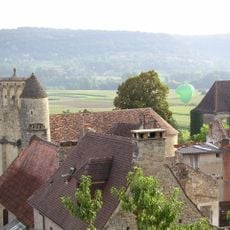
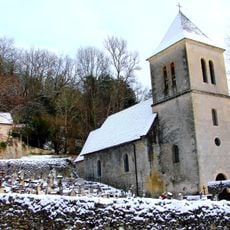
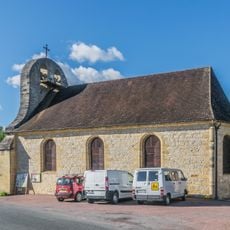
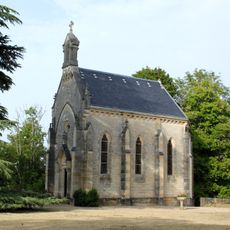
Église Saint-Cyprien de Saint-Cyprien, Romanesque church in Saint-Cyprien, France.
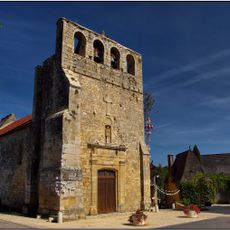
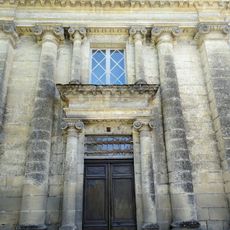
Église Saint-Cyprien is a stone church whose west facade, rebuilt in 1862-1863, has three tall narrow arched openings above a circular rose window with pale tracery, and a pointed-arch doorway with dark wooden doors; blind pointed arches flank it. Inside, a long nave under ribbed stone vaulting on pointed arches ends in an apse framing a golden altarpiece with a sunburst motif, with wooden pews and a dark wooden pulpit on the left.
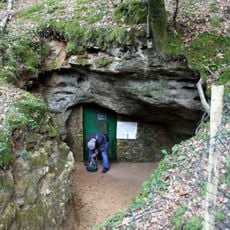
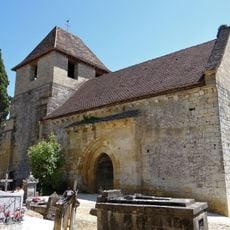
A monastery founded around the tomb of the hermit Cyprien, who settled in a cave at Fages above the Dordogne valley, stood here by legend from about 520; nothing of its 7th-century buildings survives. The church itself was built in the 13th and 14th centuries. Huguenots burned it in 1585 and used the nave to cast cannons, and the prior Jacques Dunoyer rebuilt the nave and facade from 1685. It was listed as a monument historique in 1841 and again in 1923.
The church keeps the name of Saint Cyprien, the hermit said to have settled around 520 in a cave at Fages above the Dordogne valley, drawing monks whose monastery grew around his tomb. The 17th-century organ case, probably by a Toulouse workshop, survives in the building.
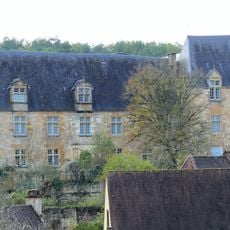
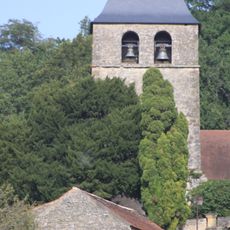
The bell tower, a 12th-century watchtower with walls nearly 1.50 m thick and arrow slits, can be visited during the Journées du Patrimoine. The church stands in the village of Saint-Cyprien in the Dordogne; the former monastic buildings beside it have served as a hospice, a library and a public hall.
The heart of Christophe de Beaumont, Archbishop of Paris exiled by Louis XV to the Château de la Roque at Meyrals, was placed in the second pillar to the right of the entrance. A relic said to be a thorn from Christ's Crown, brought in 1804 by a nun expelled from a Flemish convent, was stolen in 1997.
The community of curious travelers
AroundUs brings together thousands of curated places, local tips, and hidden gems, enriched daily by 94,244 contributors worldwide.