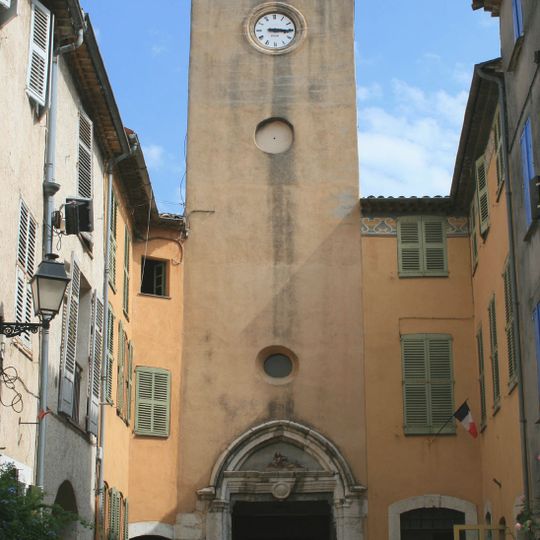
Église Sainte-Marie-Madeleine de Biot, Medieval church in Biot, France.
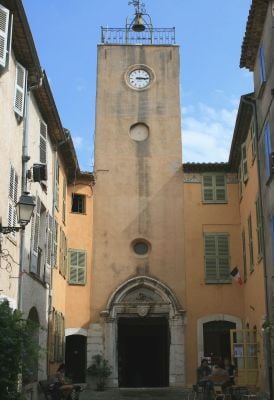
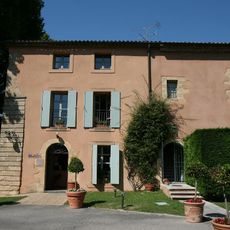
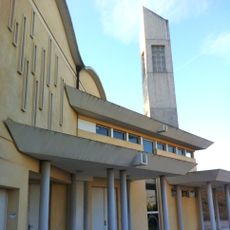
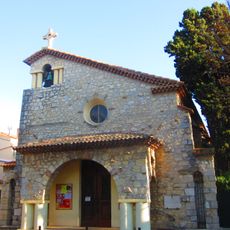
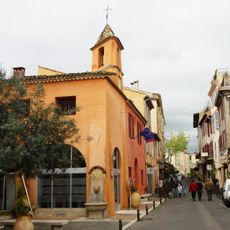
Sainte-Marie-Madeleine Church in Biot has a nave of three vessels covered with ribbed vaults and three semicircular apses. Its pale ochre bell tower, flanked by lower wings with pale green louvered shutters, carries a round clock with Roman numerals above two round openings and a large arched doorway with a carved emblem.
A first parish church stood near the castle before the first half of the 12th century; the village was depopulated in the crises of the late 14th century and that church was destroyed in 1367. King René resettled Biot with Genoese families in 1470, and a new church was rebuilt, partly reusing old elements, with three vaulted vessels and three semicircular apses. The side door was finished in 1506, the main door in 1536, and the building was classified as a monument historique on 5 December 1984.
The retable of the Virgin of the Rosary, painted around 1505 by Louis Bréa, shows the Virgin holding the child on her left arm and handing a rosary with her right; two angels hold her protective cloak wide over humanity. Kneeling below are churchmen on her right and laypeople, emperor and princes among them, on her left, all holding rosaries. Above, the Trinity: the Father holds the crucified Son, united by the dove.
The church stands in the centre of Biot, in the Alpes-Maritimes. The main door was completed in 1536 and the side door in 1506, so both are reached directly from the surrounding streets. Look down before entering: the pebble mosaic of the parvis dates from 1685 and is easy to walk over without noticing.
The pebble mosaic on the parvis in front of the church was made in 1685, as the source records. It is a dated work of local craft rather than a generic regional paving, and it lies directly before the main door finished in 1536.
The community of curious travelers
AroundUs brings together thousands of curated places, local tips, and hidden gems, enriched daily by 93,782 contributors worldwide.