Place de l'Obélisque, Protected monument in Port-Vendres, France
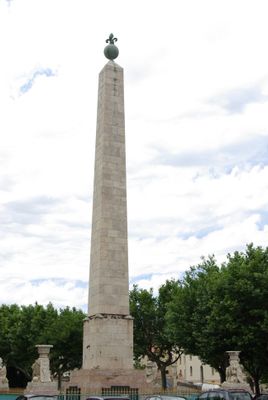
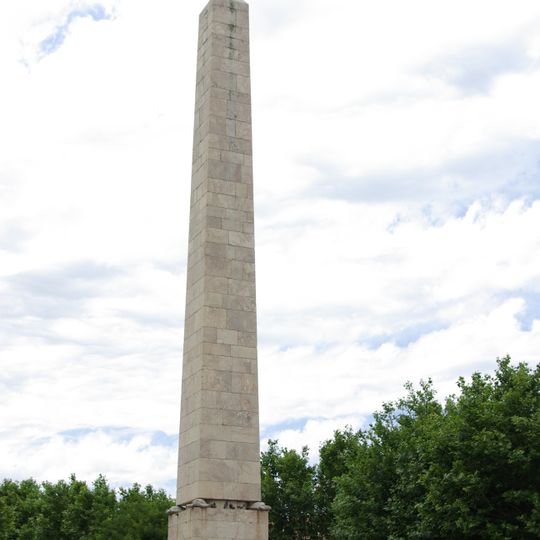
The Place de l'Obélisque is a square in Port-Vendres centred on a tall, slender obelisk of light grey and beige stone laid in horizontal courses that taper toward the top. The shaft rises from a wider base of the same stone, with a plain rectangular pedestal and a small stepped cornice between them; carved stone blocks rest on the corners of the lower section. No inscription is visible, and the monument stands among trees.
The square was laid out from 1779 as the monumental centrepiece of Charles De Wailly's planned new town for Port-Vendres, promoted by the Maréchal de Mailly under Louis XVI. The first stone of its obelisk was set on 28 September 1780, but credit ran short and only 88 inhabitants had settled by 1786. The obelisk was classified as a monument historique on 3 April 1920, the rest of the square in 1995.
The square was laid out by royal architect Charles De Wailly as the monumental centre of a planned new town, and its name honours Louis XVI. The four bas-reliefs from the obelisk's base, depicting the revived navy, free trade, the abolition of servitude and American independence, are kept in the museum in Perpignan.
The square is within walking distance from the harbor via the main street and sits centrally located. Parking spaces are found in the adjoining lanes and side streets around the square.
The obelisk was planned in red and white marble from Villefranche-de-Conflent, adorned with bronze, bas-reliefs, rostra and turtles, and topped by a terrestrial globe crowned with a fleur-de-lis. Its bronze elements disappeared in 1793, but the four bas-reliefs of the base are kept at the museum of Perpignan.
The community of curious travelers
AroundUs brings together thousands of curated places, local tips, and hidden gems, enriched daily by 92,842 contributors worldwide.